There’s a certain rhythm in Bihar’s air in December as the Nalanda Literature Festival 2025 arrives. Somewhere between that stillness and song, the NLF breathes life into history.
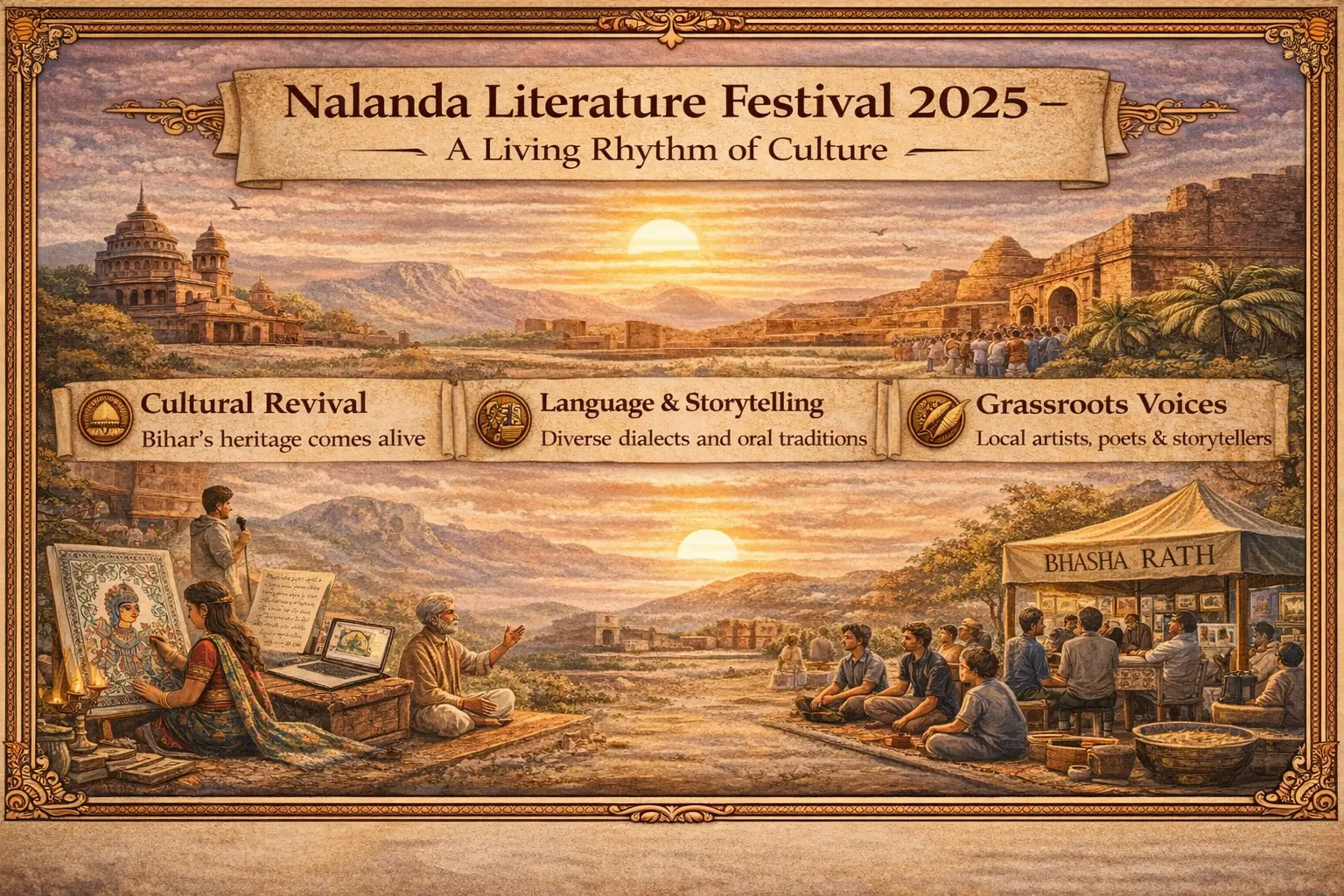
Walk through the Rajgir Convention Centre from December 21–25, 2025. The buzz of conversations in Angika, Maithili, Bajjika, Bhojpuri, and English hums like a living archive. A young poet from Bihar shares verses about migration beside a scholar from the North East decoding oral histories of the Bodo people. A translator demonstrates an AI tool that can recognise and digitise Magahi idioms, and suddenly, the age-old dialect finds new life on a glowing screen.
What makes the Nalanda Literature Festival 2025 remarkable is its layered approach to culture. It treats heritage as something breathing, something you can sit beside, talk to, and even argue with. Dhanu Bihar, the trust behind this initiative, has long believed that cultural preservation requires both empathy and innovation. When they organise language labs, it’s not an academic exercise, it’s a reunion between memory and meaning.
Picture a group of high school students in Patna participating in the “Bhasha Rath,” a travelling art and language caravan. They set up selfie booths themed around dialects, record elders narrating proverbs, and upload them to a shared archive. It’s learning disguised as play. It’s technology holding hands with tradition. And in the process, it teaches something profound, that language certainly is a tool for communication, but it’s also a map of who we are.
The NLF’s emotional core lies in its celebration of the ordinary storyteller. Folk musicians from Mithila, handloom artisans from Bhagalpur, and women weavers from Madhubani share spaces with acclaimed novelists and historians. There’s a quiet dignity in that blend, a reminder that creativity grows in every field and courtyard. A Bhojpuri ballad sung at dusk feels as powerful as any keynote address. The evening light flickers over the performers’ faces, the audience sways, and for a moment, Nalanda seems to hum again with the energy of its ancient classrooms.
Cultural experts often debate whether literature festivals risk becoming elitist gatherings detached from grassroots voices. The Nalanda festival 2025 challenges that assumption. Its workshops in smaller towns focus on youth-led cultural revival, where local teachers, farmers, and students become curators of their own heritage. It’s a decentralised model, more ecosystem than event.
And then there’s the tourism layer, subtle yet significant. Heritage walks through Rajgir’s hills and the ruins of ancient Nalanda add texture to the experience. Visitors taste local food, watch artisans carve stories into stone, and realise that culture has always lived. The festival’s synergy with Bihar’s tourism circuits has begun to create new livelihoods, offering both cultural enrichment and economic hope.
There’s something deeply human about this gathering. It acknowledges that every poem, every dialect, and every folk song carries history and hunger to be remembered. In an era where algorithms often dictate attention, the festival reminds us that true preservation begins with listening.
Perhaps Nalanda’s quiet gift to the modern world is the ability to pause, to converse, to wonder. It whispers that heritage walks beside us, waiting to be noticed in our daily rhythms, our digital screens, and our dreams.
If the rhythm of words, culture, and heritage speaks to you, the Nalanda Literature Festival 2025 is your invitation to be part of something timeless. Come to Rajgir this December, listen to stories that shaped generations, and add your own voice to Bihar’s living legacy. Every reader and dreamer has a place in this celebration. All you have to do is show up and let Nalanda’s spirit move you.
With regards
NLF Creative Team
Dated 28.10.2025
(0) Comments