

After Nalanda Fell, Where Did the Dhamma Go?
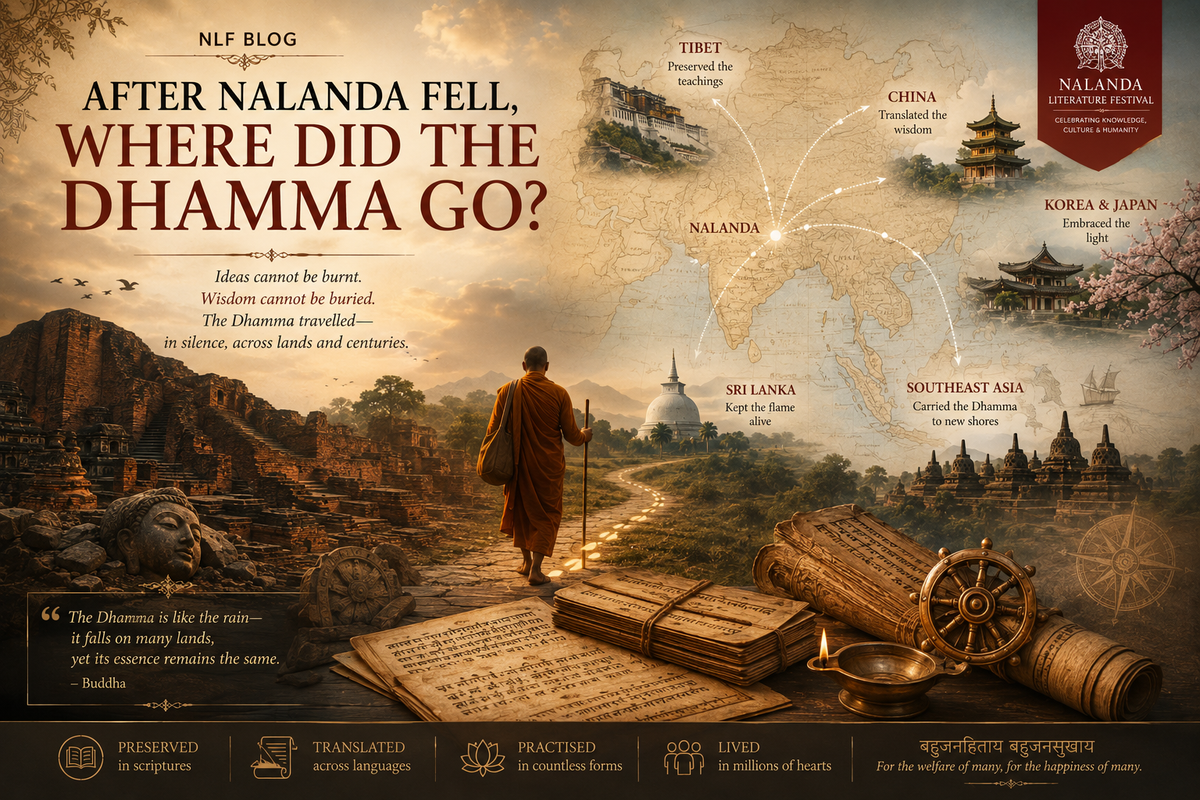
The popular story of Nalanda often ends in flames. Invaders arrive, libraries burn, monks scatter, and one of the ancient world's greatest centers of learning disappears. The tragedy is real, but the image of a single catastrophic ending is too simple. Institutions usually decline through converging pressures, and traditions rarely vanish at one dramatic moment.
Nalanda depended upon conditions. Royal patronage sustained buildings, teachers, food, and manuscripts. Political instability could weaken these supports. Shifting trade routes affected regional prosperity. Changes within Indian religious life altered patterns of authority and participation. Military violence delivered devastating blows, but it struck an institution already embedded in a changing world.
Tibetan sources preserve a haunting later image: an elderly scholar, more than ninety years old, remained at the site with a single disciple. Whether every detail can be independently confirmed, the account captures the human scale of institutional collapse. A civilization of debate, ritual, translation, and study contracts into the relationship between two people.
Yet this is not merely a picture of extinction. The presence of a disciple matters. Dhamma has always moved through transmission. A teacher speaks. A student listens, questions, practices, remembers, and eventually teaches another. Buildings magnify this process, but they do not create its essence.
Nalanda had already traveled before its decline. Pilgrims and scholars carried manuscripts, philosophical systems, ritual practices, and educational methods across Asia. Tibetan Buddhist traditions preserved the works of many Indian thinkers associated with Nalanda's intellectual heritage. Chinese travel records retained invaluable descriptions of Indian Buddhist life. Translation allowed teachings to survive beyond the political world that produced them.
This movement involved transformation. Dhamma did not enter Tibet, China, or other regions as an untouched object. It encountered new languages, institutions, artistic styles, and philosophical concerns. Adaptation could preserve the teaching, but it could also generate disagreement about authenticity.
That tension is unavoidable. A tradition that never changes may become inaccessible. A tradition that changes without discipline may lose its character. Nalanda's legacy asks how transmission can remain faithful without becoming rigid.
One answer lies in the union of study and practice. Textual preservation alone is insufficient if no one understands the texts. Meditation alone can drift if severed from ethical and philosophical guidance. Ritual alone may become mechanical. A living tradition requires these elements to correct and nourish.