

Charyapadas: Voices from the Land of Nalanda
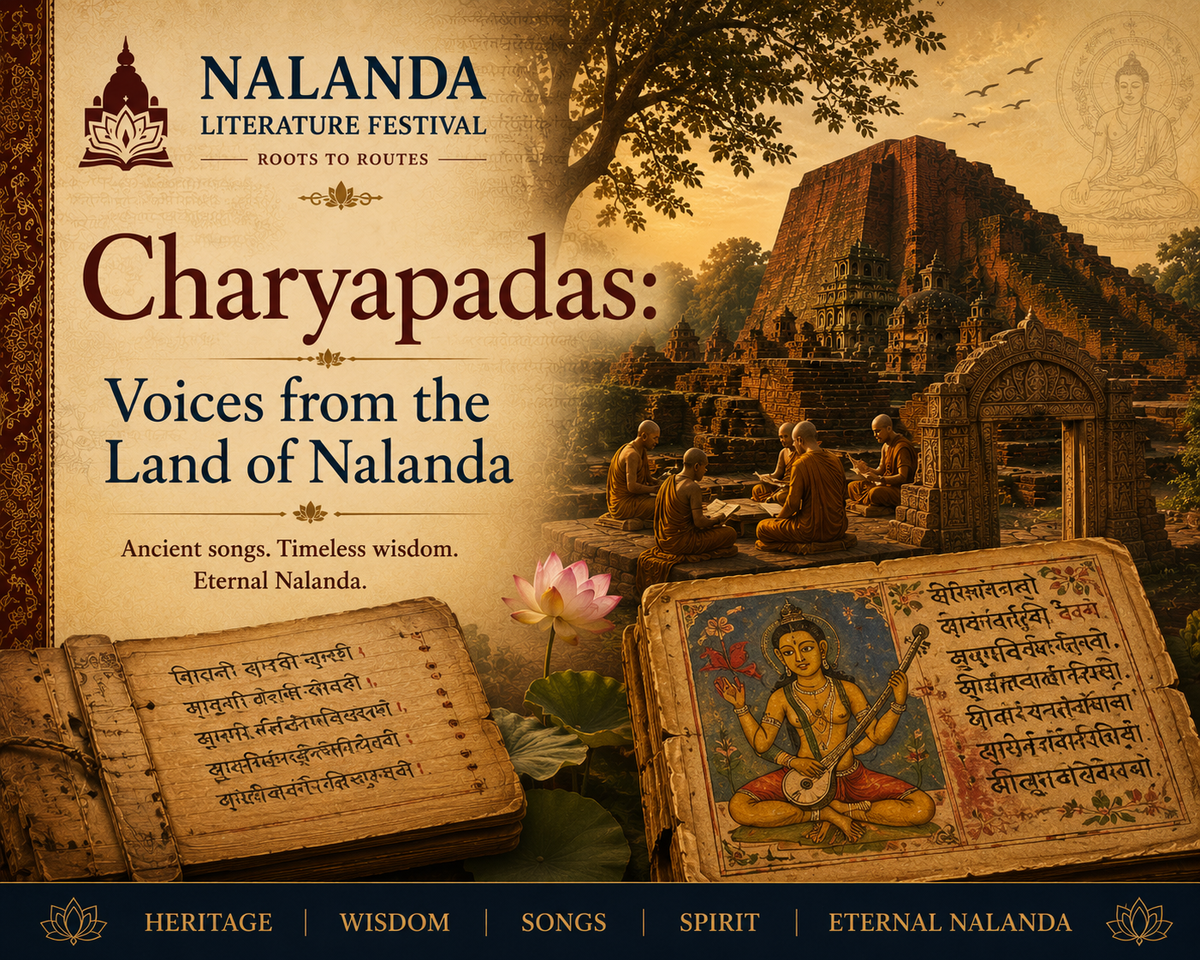
In 1907, a quiet discovery in Kathmandu changed the story of Indian literature. While exploring the Royal Library of Nepal, Mahamahopadhyaya Haraprasad Shastri uncovered a palm-leaf manuscript containing the Charyapadas – mystical songs composed between the eighth and twelfth centuries. Today, they are widely regarded as the earliest surviving poetic compositions in an early stage of the Eastern Indo-Aryan vernaculars. Yet for me, someone who grew up in the heart of Magadh, they are far more than literary relics. They are familiar voices carried across a thousand years.
History was never confined to monuments in my childhood. It echoed in the cadence of Magahi spoken in our courtyards, in Hatiya or market places, in stories shared by elders, and in the quiet presence of Nalanda’s ruins. We rightly celebrate Magadh’s extraordinary legacy of Sanskrit learning, but the Charyapadas remind us that another revolution was unfolding alongside it – one in which ordinary speech found extraordinary expression.
These songs emerged when the broader cultural world of Magadha flourished as a centre of Buddhist learning. Their composers, the Buddhist Mahāsiddhas – including Luipa, Saraha, Kanhapa and Bhusukupada – belonged to the Vajrayāna and Sahajayāna traditions. Rather than explaining Tantric philosophy directly, they cloaked it in Sandhya Bhasha, the evocative “Twilight Language,” where a boat, a lotus, a river or even a village bride could conceal profound spiritual insight. To the uninitiated, these were songs of everyday life; to seekers, they revealed an entirely different landscape.
Luipa opens the collection with remarkable simplicity:
“Kaa’ā tarubara pañca bi dāla, Cañcala cīe paisaho kāla.”
The body is like a tree with five branches; into the restless mind, time or destruction enters.
Equally memorable is Bhusukupada’s reflection:
“Apana mānse hariṇā bāirī.”
The deer’s own flesh makes it its own enemy.
Perhaps the most fascinating detail is that these verses were never meant to remain silent on palm leaves. Many were assigned ragas such as Patamanjari and Mallari, allowing philosophy to travel through melody, memory and performance. They also preserve vivid glimpses of medieval life – boatmen navigating through Ganga, potters shaping clay, hunters, dancers and village life - revealing that the sacred and the ordinary were never far apart.
The language of the Charyapadas, often described as eastern Apabhraṃśa or Abahatta, reflects a shared linguistic world from which the literary traditions of Magahi, Bhojpuri, Maithili, Angika, Bajjika, Bengali, Assamese and Odia would gradually emerge. This literary flowering belonged to the broader cultural world of ancient Magadha, whose influence extended across much of present-day Bihar and beyond. Nalanda and Vikramashila stood at its intellectual heart. Though historians cannot firmly associate every Siddha with these Mahaviharas, they emerged from the same vibrant Buddhist milieu that made Magadh one of Asia’s foremost centres of learning. Through monks, pilgrims and manuscripts, these songs travelled across eastern India and found refuge in Nepal and Tibet.
Today, Magahi, Bhojpuri, Maithili, Angika and Bajjika continue to give Bihar its many voices, while Bengali, Assamese and Odia have blossomed into celebrated literary traditions of their own. Each has travelled a remarkable journey. Yet the Charyapadas gently remind us that long before these languages acquired distinct identities, they shared a cultural conversation shaped across the broader world of ancient Magadha.
As we gather at the Nalanda Literature Festival, I often wonder how many of us truly pause to hear the history carried by the languages we speak so effortlessly every day. Perhaps that is the quiet gift of the Charyapadas: they remind us that literature does not merely preserve words; it preserves memory, music and the imagination of a people.
The next time you hear Magahi in a village courtyard, Bhojpuri in a folk song, Maithili in a poem, or the gentle cadence of Angika and Bajjika, listen a little longer. Beneath those familiar sounds still linger the voices of the Siddhas – voices that travelled from the monasteries and villages of ancient Magadha to the wider world, carrying poetry, philosophy and song together. For those of us who call this land home, that is not merely history. It is a living inheritance, still echoing through the languages of Bihar and beyond.