

The Nalanda Question: Does Anything Have an Essence?
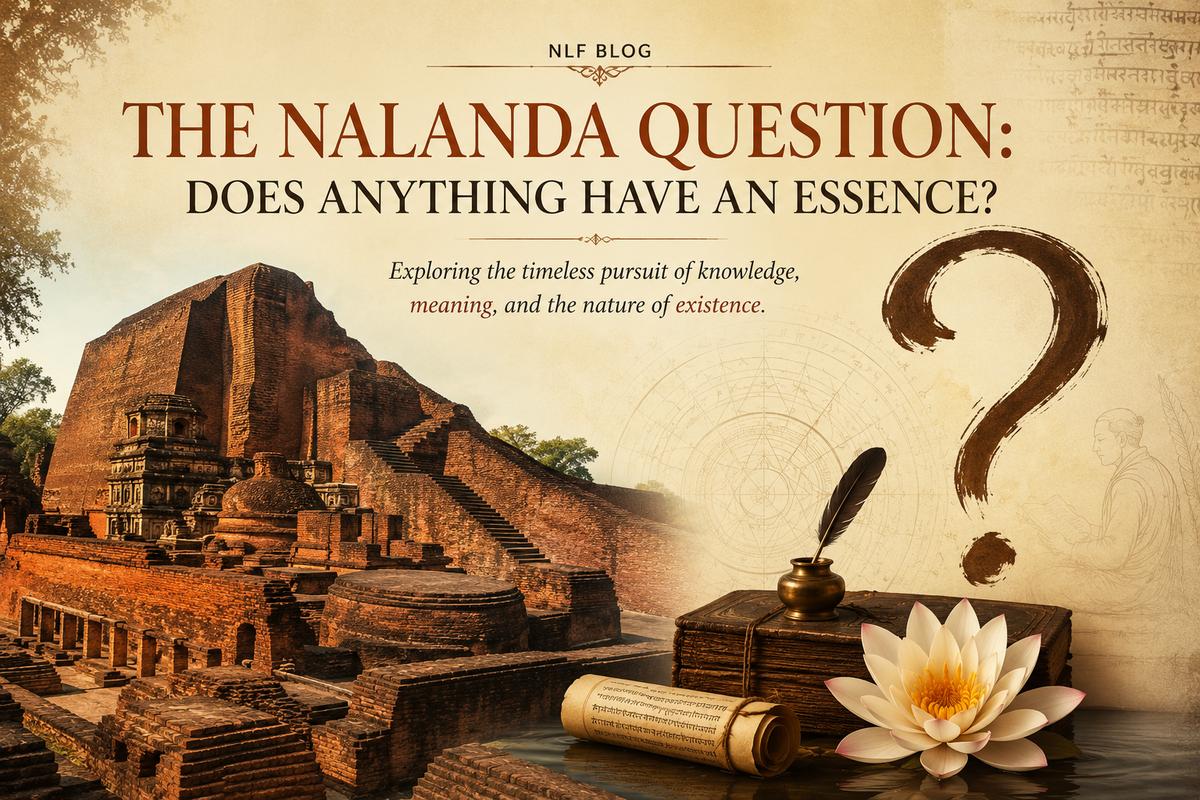
In Nalanda's debating halls, the word essence could ignite an intellectual fire. Does a person possess an unchanging core? Do objects exist through their own independent nature? Is liberation an eternal substance, or does such language misunderstand it? These were not ornamental puzzles. Their answers shaped meditation, ethics, and the meaning of awakening.
The Buddhist teaching of anatta is often reduced to the statement that no self exists. Early Buddhist discussions are subtler. They examine form, feeling, perception, volitional formations, and consciousness, then ask whether any of these unstable processes should be regarded as "mine," "I," or "my self." The practical emphasis falls on identification and attachment.
This method avoids two extremes. The first imagines an eternal self untouched by change. The second treats a human being as simply annihilated at death. Early texts frequently refuse to settle questions that trap thought within such oppositions. Their concern is not abstract victory, but the ending of suffering.
Later Mahayana philosophy widened the inquiry. Madhyamaka thinkers argued that all phenomena are empty of svabhava, meaning independent or intrinsic nature. Things arise through conditions, relations, concepts, and parts. Emptiness does not mean that nothing appears or that actions have no consequences. It means that nothing stands entirely by itself.
Consider a manuscript at Nalanda. It depends upon palm leaves, ink, a scribe, language, training, preservation, and readers. Remove these conditions and the supposedly self contained object becomes impossible to locate. Its identity is real enough for practical purposes, yet it is relational from beginning to end.
The same examination can be applied to the scholar who reads it. Memory, language, bodily sensation, cultural inheritance, aspiration, and countless encounters contribute to the person called "student." No single element is the permanent owner of all the others. The self functions, but not as an isolated essence.
Yogacara scholars explored a different dimension. They investigated how consciousness organizes experience and how conceptual habits make constructed appearances seem independently real. Their analyses of cognition could be read as rivals to Madhyamaka, but they also supplied complementary tools. One tradition questioned what things are; the other scrutinized how things are experienced.
Nalanda became famous partly because such differences could coexist within a shared pursuit. Philosophical disagreement did not always mean that one side represented authentic Buddhism and the other error. Different systems might attack different forms of clinging.
The danger lay in turning emptiness itself into a metaphysical substance. If one begins to imagine emptiness as the hidden essence behind the world, the teaching defeats its own purpose. Emptiness is also empty. It is a way of correcting reification, not a final object to possess.
This is where philosophy returns to conduct. If the self is relational and conditioned, arrogance loses some of its foundation. If anger depends upon interpretation, memory, and repeated attention, it need not be treated as destiny. If institutions arise through conditions, they must be sustained rather than assumed permanent.
Nalanda itself demonstrates this truth. It flourished through patronage, teachers, students, trade routes, political stability, and intellectual exchange. When conditions changed, the institution declined. Its grandeur never made it independent.
Emptiness is therefore not a doctrine of despair. It is the possibility of transformation. What depends upon conditions can change when conditions change. That insight gave Nalanda's philosophy its precision and the Dhamma its therapeutic power.