

Why Nalanda Monks Studied Their Opponents?
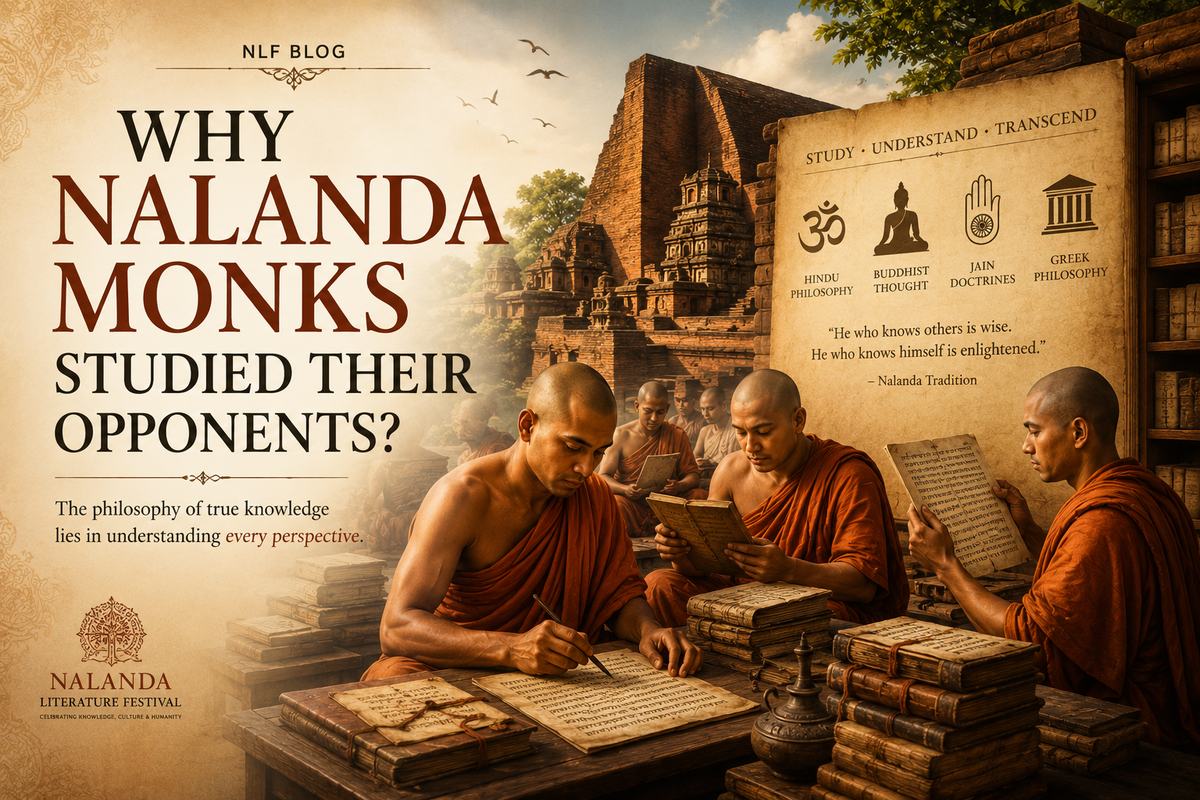
Nalanda's scholars did something that modern readers may find surprising. They studied ideas they did not accept. Buddhist monks examined Vedic thought, Samkhya philosophy, grammar, medicine, and competing Buddhist systems. They did not protect the Dhamma by sealing it away. They placed it in conversation with powerful alternatives.
This approach grew from a distinctive confidence. A teaching that claims to diminish ignorance should withstand careful inquiry. At Nalanda, disagreement could become a method of refinement. A student learned not only what a school asserted, but also how its arguments worked, what assumptions supported them, and where their consequences led.
Formal debate demanded more than eloquence. Indian traditions of reasoning developed exact standards for claims, evidence, examples, and inference. A debater had to identify whether an argument genuinely proved its conclusion. Ambiguous language, circular reasoning, and irrelevant evidence could be exposed before an audience.
Such training served a spiritual purpose. Buddhism repeatedly warns that attachment to views can become another form of bondage. This includes attachment to Buddhist views when they are held merely as badges of identity. Debate forced scholars to articulate their positions and face objections. It made inherited language answerable to reason.
Yet Nalanda's debates were not always contests with one final victor. A traditional account involving Chandrakirti and Chandragomin illustrates this beautifully. The two figures are associated with opposing philosophical tendencies, Madhyamaka and Yogacara. In the story, the bodhisattvas Manjushri and Avalokiteshvara support different participants. The tale suggests that profound understanding may emerge through opposition rather than through the total defeat of one side.
Madhyamaka challenged the belief that things possess fixed, independent essence. Yogacara examined how experience is structured by consciousness and conceptual construction. Their vocabulary and arguments differed sharply. Still, both sought to loosen the mind's grasp on appearances. Debate between them could reveal dimensions of the Dhamma that a single system might leave concealed.
The willingness to study outsiders also guarded against caricature. It is easy to dismiss a position one has never understood. Nalanda's intellectual culture demanded something harder: represent an opponent accurately before attempting a reply. This principle remains essential to serious scholarship and ethical conversation.
There was courage in such openness. Encountering a persuasive alternative may unsettle cherished assumptions. It can expose gaps in one's training or reveal that a familiar doctrine has been repeated without comprehension. Nalanda treated this discomfort as productive. Intellectual humility was not weakness. It was a condition of learning.
The institution's breadth also reminds us that Dhamma was not isolated from the wider world. Medicine addressed bodily suffering. Grammar secured the interpretation of texts. Logic clarified thought. The arts shaped perception and devotion. Even non Buddhist philosophy could become part of a Buddhist education when studied with discernment.
Nalanda therefore offers a demanding standard for dialogue. Genuine debate is neither polite vagueness nor aggressive performance. It requires patience, accuracy, self command, and a willingness to be changed. The aim is not to protect one's pride. It is to see more clearly.
In that sense, Nalanda's debating halls were extensions of meditation practice. Both required attention to how the mind constructs certainty. Both exposed hidden attachment. Both asked a question that remains alive: do we seek truth, or merely the pleasure of being right?