

Magahi: The Living Tongue of Magadha
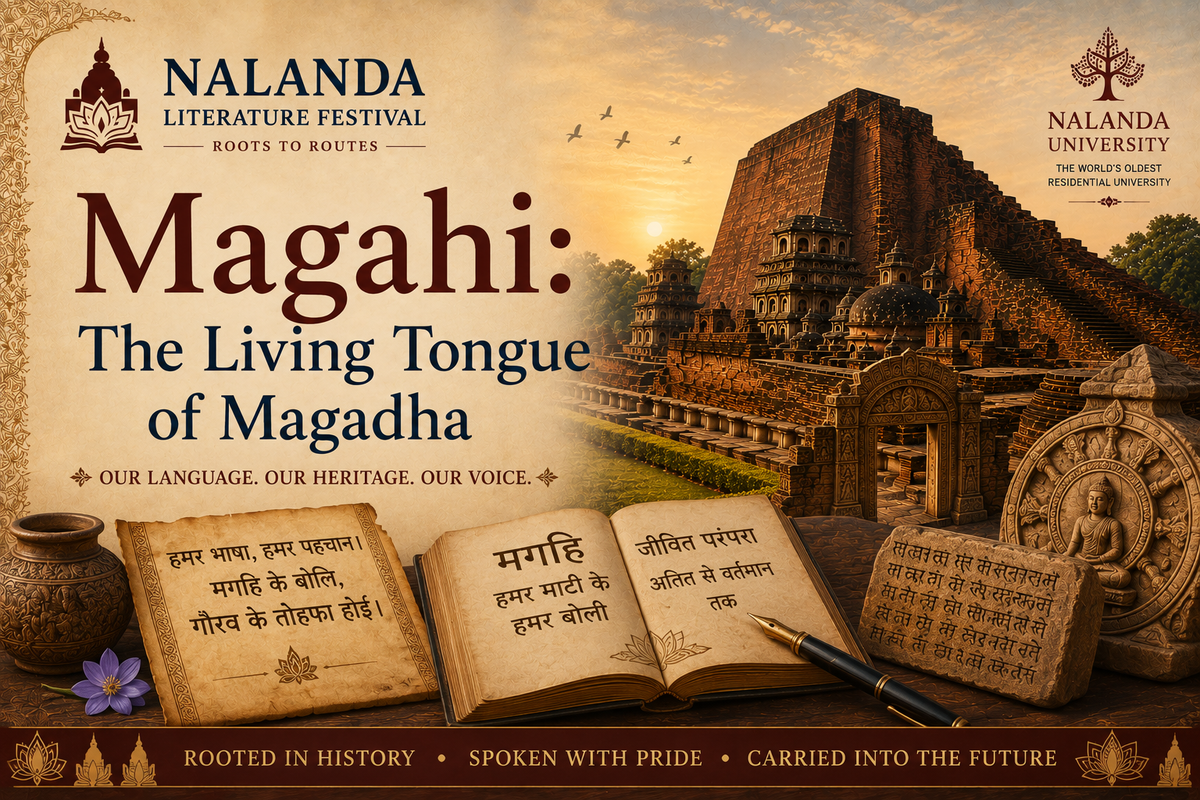
How a regional language still carries the cadence of an ancient empire
Across the hallowed landscapes of ancient India, where the stone ramparts of Rajgir and the monastic courtyards of Nalanda once stood, a distinct melody echoed through the corridors of power. This was Magadha — the imperial cradle of the Maurya and Gupta dynasties.
Today, while its majestic palaces have crumbled into quiet ruins, the true legacy of Magadha endures in the breath of a language that refuses to fade: Magahi. For those raised in its warmth, speaking Magahi feels less like deploying a regional dialect and more like carrying the living pulse of an empire. Descended directly from Magadhi Prakrit — the administrative tongue of royal courts, the Buddha's sermons, and several of Ashoka's rock and pillar edicts — Magahi is spoken today by roughly 12.7 million people across Bihar, Jharkhand, parts of West Bengal and Odisha, and the Terai of Nepal.
Its literary lineage stretches from the mystical verses of the Charyapada — whose Siddha poets, Rahul Sankrityayan argued, were largely from Bihar and wrote in an early form of Magadhi — to the Dohakosha of Sarahapa, where the distinct shape of the language first becomes visible, and onward to a quiet modern renaissance. Yet for centuries this richness survived almost entirely in the air: in songs, in stories, in the cadence of a grandmother's voice.
The Acoustic Architecture of an Empire's Tongue
To an attentive listener, Magahi is immediately captivating for its acoustic architecture. It flows with an inherently musical cadence, shaped by a phonetic preference for shortening long vowels and an intricate verbal inflection system that shifts with social intimacy. A standard phrase like “U jaa rahali hai” (She is going) effortlessly condenses into the swift, rhythmic “U jaa-hi-hai.” This linguistic playfulness is not mere grammar; it is the everyday music of a people.
The vocabulary reflects a rich historical tapestry. While firmly grounded in Prakrit and Sanskrit (tatsam words), centuries of imperial shifts have woven in Persian courtly expressions, a legacy of the Mughal and later administrations that governed from Patna and Bihar Sharif. Meanwhile, everyday speech carries an irreplaceable earthy resonance — words like aego (one), upah (out of sight), anbhuar (the strange, heavy stillness before dawn), or gachhi (orchard) bridge a rustic present with a majestic past. Anbhuar, in particular, is a word that needs no translation: it names the hush of a village before the first cock-crow, a silence so specific that no English equivalent quite holds it.
Magahi was historically written in the Kaithi script, the mercantile and administrative hand of the eastern Gangetic plain, before Devanagari became the dominant script in the modern era. It has also appeared in the Bengali and Odia scripts in border regions. Despite this depth, Magahi is classified as a dialect of Hindi in the Indian Census since 1961 rather than recognised as a distinct scheduled language — a point of lingering contention among its speakers and scholars, who note that the language predates and parented several modern tongues, including Bengali, Assamese, and Odia.
Where the Soul Lives: Oral Traditions of Magadh
The true soul of this region thrives in its visceral oral traditions. During the sacred Mahaparv of Chhath, the meditative melodies of Chhath Geet float across the riverbanks and village ponds. Tied to ancient solar shrines like the Deo Sun Temple in Aurangabad — an 8th-century, west-facing shrine widely regarded as the birthplace of the Chhath tradition and mentioned in the poet Mayura Bhatta's Surya Shataka — these chants define the region's spiritual devotion. The Deo temple draws lakhs of pilgrims each Kartik, and the festival itself, with its rigorous fasting and offerings of arghya to the setting and rising sun, is perhaps the most visible cultural expression of the Magahispeaking heartland.
This innate musicality spills into daily life. The rhythmic paddy-transplantation songs of the monsoon — Ropani geet — synchronise labour in the flooded fields, their beats matching the slap of bare feet on wet mud. The harvest brings katni geet; weddings bring samdaun, the women's bidai songs. The devotional Domkach, with its circular rhythmic clapping, and the spirited Magahi Jhumar — a duet of husband and wife trading playful promises of ornaments and finery — carry the community's joy. Even leisure carries the old music: bards still perform the ballads of Lorikayan (the Song of Lorik) and the Song of Gopichandra, epic narratives of love, renunciation, and heroism that have travelled orally for centuries and vary with every telling.
From Memory to Print: The Literary Awakening
While oral heritage sustained the language through generations, a print movement cemented its modern literary foundation. The landmark arrived on April 1, 1928 — fittingly, April Fools' Day — with Jayanath Pati's Phool Bahadur, the earliest surviving full-length novel in Magahi. Pati, a mukhtar (colonial-era legal practitioner) from Nawada in Gaya district, was a polyglot versed in Urdu, Persian, Sanskrit, English, Bengali, and Latin. His actual first novel, Sunita (1927), was lost to time; Phool Bahadur is the earliest Magahi novel whose copy survives, and it was followed the same year by a third, Gadahnit.
Set in colonial Bihar Sharif, Phool Bahadur is a sharp satire on bureaucracy and ambition: its protagonist, the mukhtar Babu Samlal, is duped on April Fools' Day by pranksters who bestow on him the fake title of “Rai Bahadur,” something he desperately covets. Through Samlal's travails, Pati skewers the rampant corruption of the colonial judiciary and administration, proving that Magahi could carry complex social commentary with nuance and wit. The novel appeared in the same year, 1928, as Premchand's Gaban — Pati was writing his regional satire in Magadh even as Premchand was shaping the modern Hindi novel.
Decades later, Sheela Verma's Magahi Folklore and Folk Tales (Manohar, 2008) brought local riddles, idioms, proverbs, and folk tales into academic focus, granting the region's oral archive a permanent place in written literature. Verma, Lecturer Emerita at the University of Wisconsin–Madison and author of the foundational The Structure of the Magahi Verb (1985), produced the first systematic English translation and commentary of Magahi folklore — an act of cultural recovery that made tales like The King's Daughter Dove and Princess Belmanti accessible to scholars beyond the language's borders.
More recently, poet-diplomat Abhay K.'s English translation of Phool Bahadur, published as a Penguin Modern Classic in 2024, has given the novel — and with it the Magahi language — its widest readership yet, nearly a century after Pati first set it in print.
A Living Language, Not a Relic
Magahi endures, quietly and stubbornly, in the tender cadence of grandmothers' stories, the high-spirited rhythms of the harvest, and the sharp prose of contemporary writers. It lives in the songs women sing while grinding grain, in the ribald wit of wedding-night verses, in the devotional hush of a Chhath ghat at dawn. It has survived the rise and fall of empires, the dominance of Sanskrit, the long centuries of Persian court culture, the standardising push of modern Hindi, and the indifference of a census that refuses to count it as itself.
That survival is not accidental. A language that gave the Buddha his first audience, that Ashoka chose for his edicts of moral governance, that birthed the mystic songs of the Siddhas, and that still names the silence before dawn carries within it a particular, unbreakable vitality. Magahi is neither a static relic of antiquity nor a tongue confined to the agricultural fields. It is the ancient voice of Magadha — imperfectly preserved, endlessly reinvented, and still very much alive.