

Mauli: A Journey into Ancient Indian and Magadhan Headwear
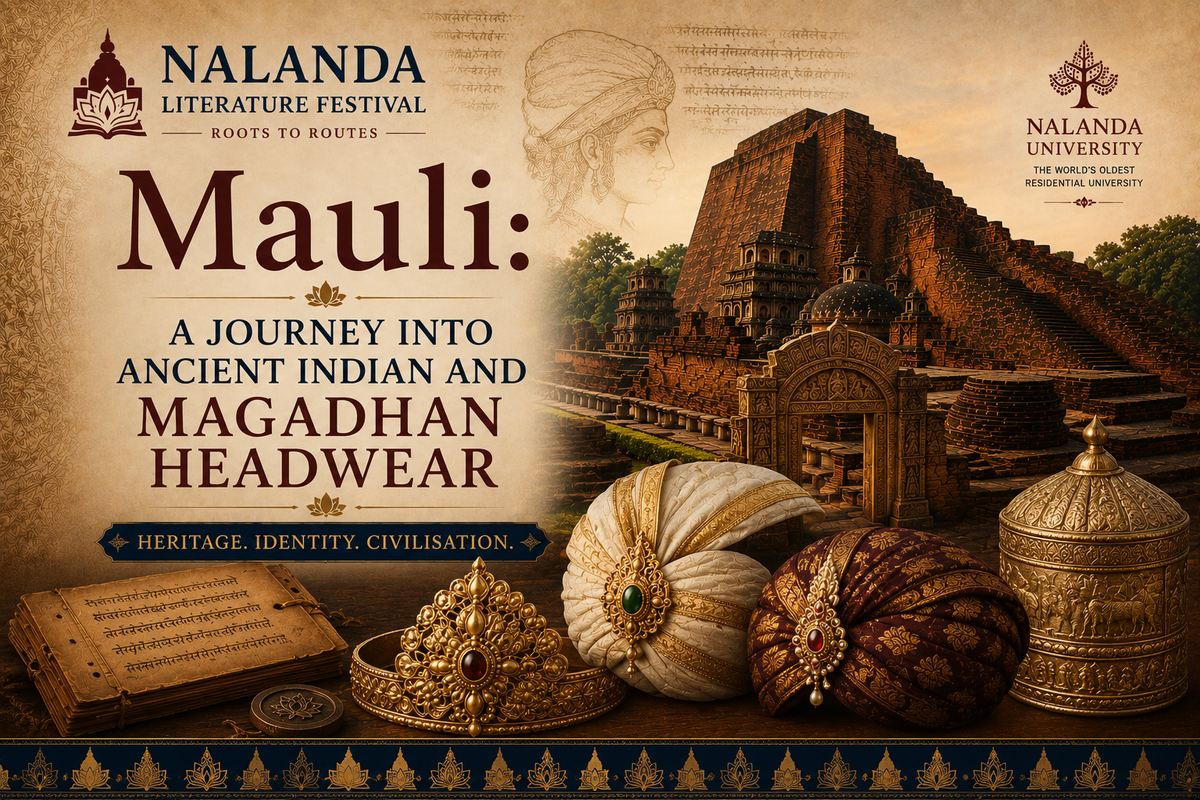
How a sacred art of adornment became a visual language of identity, rank, and divine authority
Across the ancient world, headwear was far more than a defence against the elements — it was a visual language of identity, social hierarchy, and spiritual authority. In early Indian culture, the human head was viewed as the seat of vital energy (prana), making its adornment a sacred and deliberate art. From the elaborate coiffures depicted on Indus Valley terracotta figurines — where combs and stylised hair arrangements prove a deep-rooted inclination toward ornamentation — to the grand crowns of epic literature, headgear served as a person’s ultimate public statement.
A Grammar of Adornment in Classical Texts
In classical Sanskrit and Prakrit literature, as well as in dramatic treatises like Bharata’s Natyashastra, headwear and hair adornment fell under the technical category of Aharya Abhinaya — the art of external costume, makeup, and ornamentation. Bharata devoted the entire twenty-third chapter of the Natyashastra to this subject, classifying it into four subdivisions: pusta (stage props and models), alankara (decoration with ornaments and flowers), angaracana (painting of the body), and sanjiva (living creatures and animals). Aharya was considered so powerful that, according to Bharata, the appearance of a character in the right costume alone could communicate their nature, rank, and state of mind before a single word was spoken or gesture performed.
Literature of the period meticulously records various forms of headgear. The three principal crowns described across Sanskrit texts were the mukut (a crescent-shaped diadem or crown, usually of gold and sometimes set with gems), the kirita (a pointed, conical tiara associated specifically with sovereignty — Arjuna’s kirita from Indra being the most celebrated in the Mahabharata), and the mauli (a three-pointed crown). According to Bharata, the mukut itself came in three types, corresponding to the rank of the wearer. At the centre of the crown sat the chudamani, a crest-jewel — a single perforated gem tied over the turban or crown with a string, described in the Markandeya Purana as the best among all ornaments. The Mahabharata frequently uses the compound “baddhachudamani” (tied crest-jewel) to indicate this precise method of fastening.
Interwoven with these metallic crowns were natural adornments: lush floral garlands (srak), often intertwined with gold threads, and strings of pearls (muktajala) woven directly into complex hairstyles. The Manasara, a silpa text on architecture and sculpture, classifies headgear into eleven types — from jata (matted hair) and karanda (basket-shaped crown) to dhammilla (a coiffure) and three kinds of ornamental bands (patrapatta, ratnapatta, and pushpapatta) — each assigned to different ranks of kings, queens, and deities, revealing an extraordinarily codified system of visual hierarchy.
Where the Art Flourished: Magadha and Its Material World
Nowhere did this art form flourish more dramatically than in the ancient realm of Magadha. As the political and cultural epicentre of early India, Magadha — with its capitals at Rajgir (ancient Girivrajja) and later Pataliputra (modern Patna) — developed a highly sophisticated material culture from the sixth century BCE onward, through the Haryanka, Nanda, Maurya, and Sunga dynasties. Its core territory corresponded to the modern Patna and Gaya districts of Bihar, bounded by the Ganga, Son, and Champa rivers. The broader Magadhan sphere of influence eventually absorbed neighbouring regions, including the Vajji confederacy with its capital at Vaishali — an aristocratic republic conquered by Ajatashatru in the fifth century BCE — and ancient settlements like Buxar (Vedagarbha), where terracotta sculptures dating to the second and first centuries BCE have been found.
Extensive archaeological excavations across Bihar have unearthed hundreds of Mauryan and Sunga-period terracotta figurines that serve as living archives of this era. At Kumrahar, the site of a Mauryan pillared hall discovered by D. B. Spooner in 1912–13, and at Bulandibagh, where M. Ghosh excavated in 1926–28, the figurines span from the pre-Mauryan period through the Sunga, Kushan, and Gupta eras. Unlike the idealised stone sculptures of later centuries, these clay artefacts — moulded faces with handmodelled bodies and appliquéd clothes, headdresses, and ornaments — capture the daily aesthetic choices of Magadhan society.
Among the most celebrated finds are the so-called “dancers” of Bulandibagh: refined terracotta figurines with moulded faces, handmade bodies, and appliquéd headdresses, one of which displays an intricate headpiece showing clear Hellenistic influence — evidence of the artistic exchange between the Mauryan court and the Greek world. The companion busts known as the “Smiling Boy” and “Smiling Girl,” also from Bulandibagh and now housed at the Bihar Museum, further reveal elaborate headdress styles that draw from both indigenous and Hellenistic traditions. The boy’s unrestrained laughter and the girl’s restrained composure, each crowned with distinctive headwear, offer a rare window into the gendered norms of self-presentation in Mauryan society.
A Civilization Obsessed with Form
Together, these clay fragments reveal an era where both men and women adorned their heads with towering, architectural structures crafted from fine native textiles, hidden frameworks, and precious metals. They show a civilization that treated the head as a canvas for form, symmetry, and visual grandeur — where a silk turban, a gold fillet, or a single crest-jewel could declare a person’s rank, lineage, and aspirations at a glance. As we explore the distinct styles of Magadhan men and women in the features that follow, we discover a culture where what one wore on one’s head was never merely decorative. It was a statement of who one was — and who one wished the world to see.