

PART 2: The Temple of Devotion and the Literature of the Masses – Saint Namdev
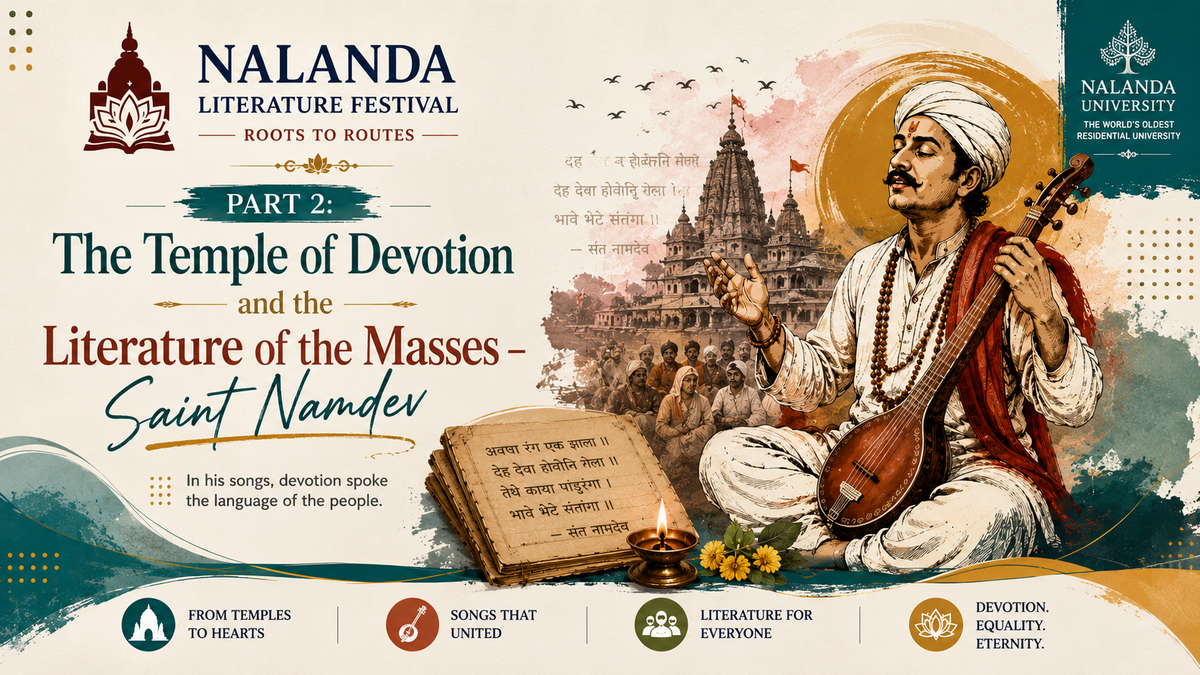
"Nāmā mhaṇē āmhi kīrtanācē raṅgī। Jñānadīpa lāvū jagā mājhī॥"
— "Through the joy of devotional singing, we shall ignite the lamp of wisdom across the world."
When Saint Dnyaneshwar laid the foundational stone of Marathi literature, it was a young, passionate reformer who carried its light across geographical boundaries and social strata. His name was Saint Namdev. If Dnyaneshwar provided Marathi literature with its philosophical core, Saint Namdev transformed it into a vibrant, living movement of the masses.
At the Nalanda Literature Festival (NLF), we honor literary figures who used their craft as a bridge to unite diverse cultures and communities. Saint Namdev stands out as an early champion of this inclusive ideal. His literature went beyond spiritual expression—it was a powerful medium for social unity, equality, and cultural harmony.
Saint Namdev pioneered the art of Abhang poetry and Kirtan (musical discourse). His verses were not written in complex classical style; they flowed directly in the simple, rhythmic, and soulful dialect of the common people. Through his compositions, literature ceased to be an academic exercise and became a shared human experience. He traveled far beyond Maharashtra, journeying to Punjab, where his poetry resonated so deeply that 61 of his hymns were eventually enshrined in the Sikh holy scripture, the Sri Guru Granth Sahib—a rare cross-cultural tribute in Indian history.
Alongside contemporary women poets like Janabai and voices from every section of society, Namdev created an open literary space. This democratized literature ensured that poetry belonged equally to artisans, farmers, and scholars alike.
Through Saint Namdev's visionary works, Marathi literature became a national force for unity and brotherhood—embodying the spirit of cultural bridge-building that NLF proudly celebrates today.
To Be Continued (क्रमशः):
After the sweeping cultural revolution of Saint Namdev, Maharashtra faced turbulent political shifts. Yet, amidst these challenges arose a powerful literary figure whose fearless satire, moral courage, and massive 4,000+ Abhangs inspired both common citizens and kings alike! Who was this saint whose poetry literally survived drowning to become immortal? Find out in Part 3: The Unshakable Pillar of Moral Courage – Saint Tukaram.