
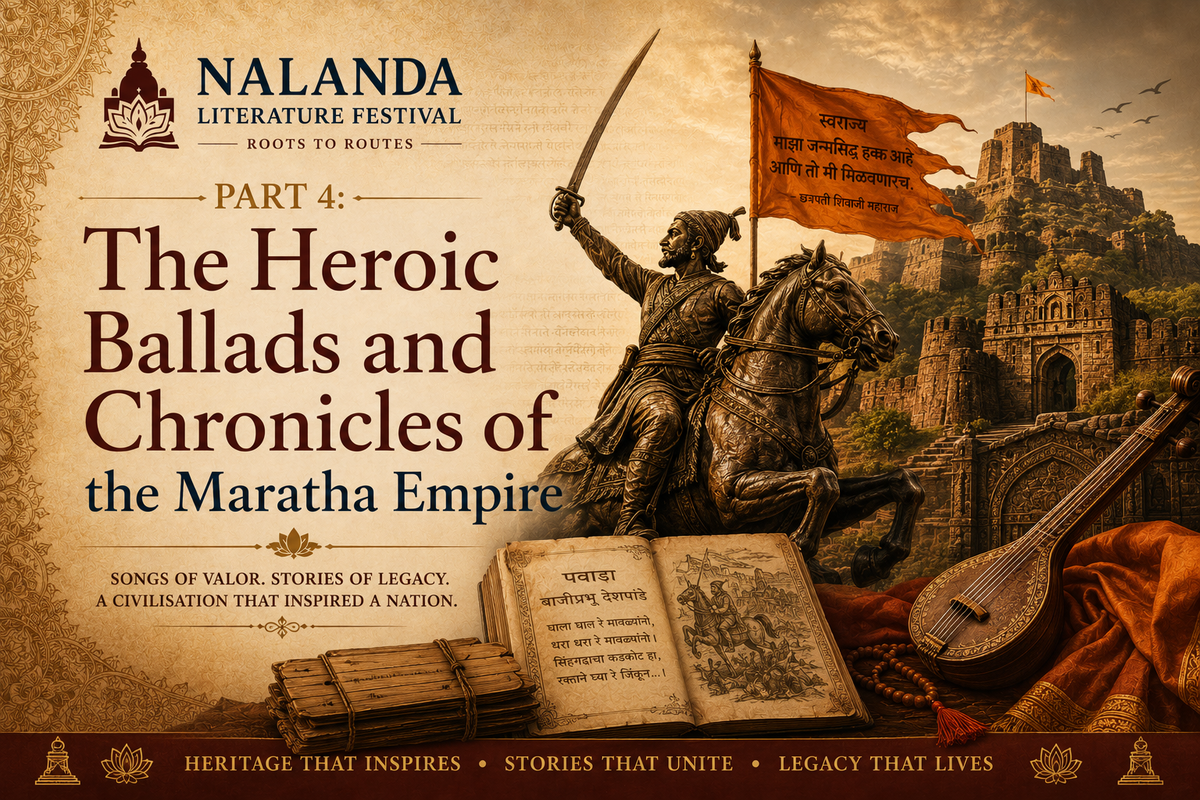
PART 4: The Heroic Ballads and Chronicles of the Maratha Empire
"Vedāt Marāṭhe vīr dauḍle sāt!"
— "Wild with valor, seven Maratha warriors charged into battle!"
The 17th century marked a dramatic turning point in Maharashtra's history. Under the visionary leadership of Chhatrapati Shivaji Maharaj, the region experienced a monumental political, social, and cultural awakening. This golden era demanded a new literary voice—one that resonated with bravery, administrative clarity, and unyielding self-respect. At the Nalanda Literature Festival (NLF), we highlight how literature adapts during pivotal historical moments to galvanize societies. During the Maratha Empire, literature transformed from spiritual introspection into vivid historical documentation and stirring heroic art forms.
This period gave birth to Bakhar (historical prose chronicles) and Powada (heroic ballads). Bakhars, such as the Sabhasad Bakhar, provided crucial historical records, military strategies, and administrative insights in refined Marathi prose. Simultaneously, Shahir poets like Agnaldas and Tulsidas composed high-energy Powadas celebrating iconic historic battles, such as the defense of Sinhagad by Tanaji Malusare.
Furthermore, Shivaji Maharaj commissioned the creation of the Rajyavyavahar Kosh, a comprehensive administrative dictionary aimed at replacing foreign court terminology with indigenous Marathi and Sanskrit terms. This conscious linguistic revival protected regional identity and established Marathi as a formal language of governance.
Through heroic ballads, strategic chronicles, and deliberate language preservation, the Maratha era demonstrated that literature can serve as the ultimate guardian of freedom and cultural sovereignty—an inspiring chapter that NLF proudly brings to global audiences.
To Be Continued (क्रमशः):**
Following the martial glory of the Maratha Empire, the 18th century ushered in an era of rich folk theater, musical storytelling, and vibrant social satire under the Peshwa court! How did the 'Lavani' and 'Tamasha' folk traditions enrich regional literature? Find out in Part 5: Folk Artistry and the Rhythms of Shahiri Literature.