
PART 7: Romanticism and Revolution – The Golden Era of Modern Poetry
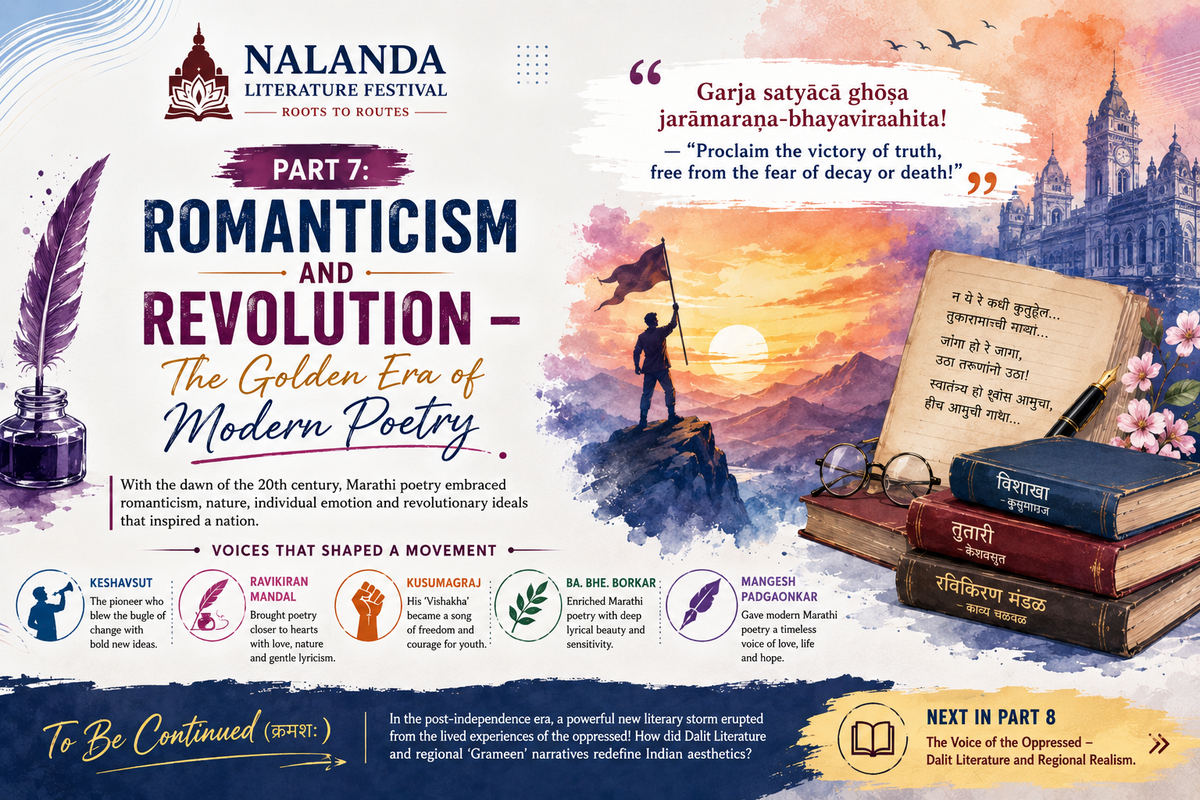
"Garja satyācā ghōṣa jarāmaraṇa-bhayaviraahita!"
— "Proclaim the victory of truth, free from the fear of decay or death!"
With the dawn of the 20th century, Marathi literature entered a mesmerizing phase where poetic expression broke free from classical constraints. Modern Marathi poetry became an intoxicating blend of deep individual romance, nature worship, and fiery revolutionary idealism aimed at national liberation.
At the Nalanda Literature Festival (NLF), we honor poetic movements that capture both the delicate nuances of human emotion and the thunderous call for social liberty. The modern Marathi poetic movement embodies this duality perfectly.
Pioneer poet Keshavsut, often heralded as the father of modern Marathi poetry, famously declared a war on social stagnation through poems like Tutari (The Bugle). He introduced individualism, universal humanism, and lyrical freedom. Following him, the Ravikiran Mandal poetry circle humanized poetry, bringing it into middle-class homes with gentle themes of love and nature.
The movement reached its lyrical peak with Kusumagraj (Vishnu Vaman Shirwadkar), whose landmark collection Vishakha served as an anthem for India's freedom struggle. His fiery poems infused youth with courage, patriotically calling for the destruction of colonial bondage. Similarly, Ba. Bhe. Borkar and Mangesh Padgaonkar enriched lyricism with exquisite aesthetic depth.
By blending intense personal emotionality with patriotic fervor, this golden era proved that poetry can simultaneously touch the individual heart and ignite national movements—a literary magic that NLF celebrates with great passion.
To Be Continued (क्रमशः):**
In the post-independence era, a powerful new literary storm erupted from the lived experiences of the oppressed! How did Dalit Literature and regional 'Grameen' narratives redefine Indian aesthetics? Find out in Part 8: The Voice of the Oppressed – Dalit Literature and Regional Realism.