

Silk, Gold, and Blossoms: The Headdresses of Magadhan Women
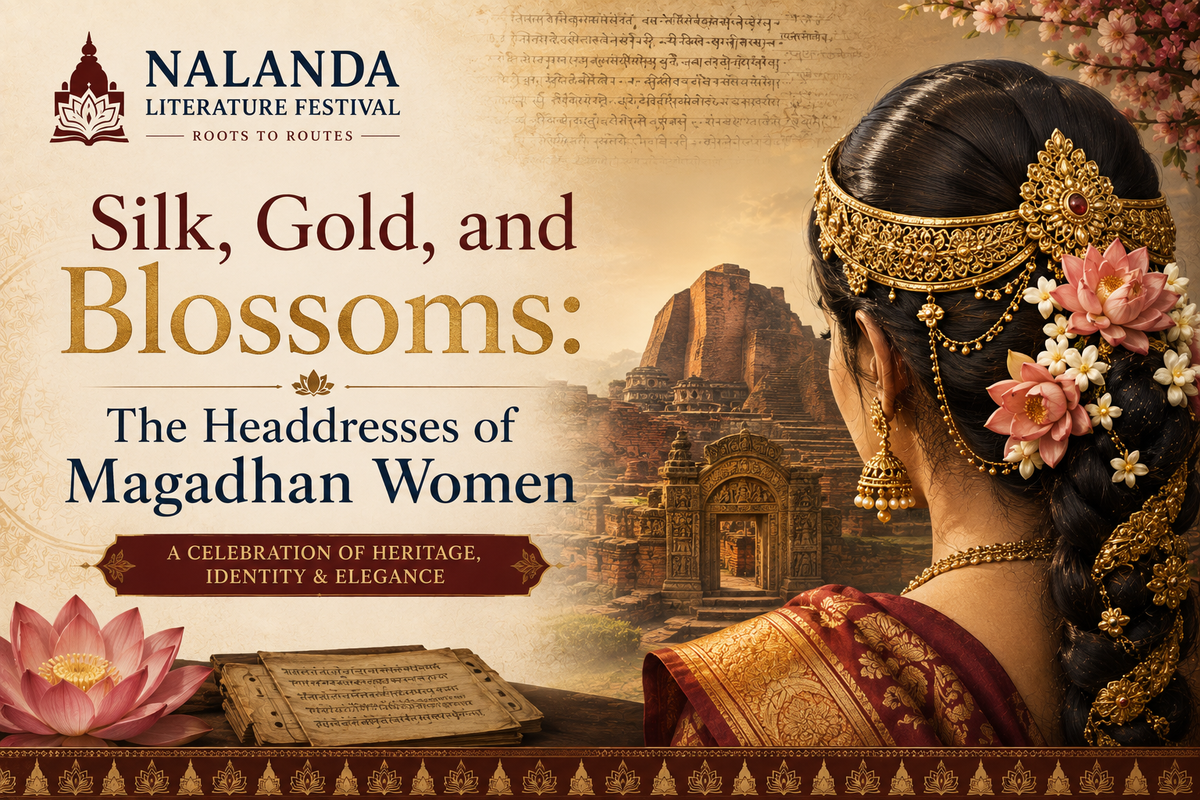
How the women of ancient Bihar sculpted their hair into an art of wings, jewels, and solar motifs
If male headgear in ancient Magadha was defined by regal structure, the hair ornamentation of Magadhan women was an absolute masterclass in artistic drama and exquisite jeweller’s craft. The terracotta figurines excavated from Bulandibagh, Kumrahar, and other sites across Patna reveal that hair was not merely arranged — it was sculpted, studded, and woven into an elaborate canvas of material luxury.
Coiffures as Architecture: Fabric, Framework, and Form
Women of Greater Magadha transformed coiffures into structural art. They wrapped fine native cottons and imported dukula — a prized silk mentioned in Buddhist and Sanskrit literature as a soft, luminous fabric — over lightweight inner frameworks made of reeds or padded cloth, building fan-shaped coiffures that extended outward like open wings. Broad lateral plaques flanked the head, with fabric ribbons cascading down past the ears. These textile structures were stamped with geometric patterns, rosettes, and solar wheel (chakra) motifs, representing heavy embroidery or metallic appliqués.
The archaeological record brings these descriptions to life with remarkable specificity. A female figurine from Kumrahar, identified as a Mother Goddess, shows hair adorned with a double pearl string terminated at the sides in circular rings of pearls; her headdress comprises side rolls with a central boss stamped with a floral design. Another specimen from Mahabirghat shows a beautiful woman with a headdress resembling a turban, probably tied with a pearl-string just near the right ear. The Sunga-Kushan figurines from Kumrahar, all moulded from red clay, are described by excavators as having “heavy headdresses with various styles” — each one distinct, each one a small masterpiece of the clay modeller’s craft.
The Mukut and the Chudamani: Jewels of the Crown
Yet it was the delicate jewellery pinned into these coiffures that truly defined Magadhan elegance. At the forehead sat the mukut — a crescent or tiara-like gold band anchored across the hairline. While the mukut is most frequently described in literature in connection with men, the Manasara explicitly states that the dhammilla (an elaborate coiffure) and the mukut are fit for the queens of various classes of kings, confirming that royal women wore crowns of their own. Nestled centrally at the crown or side-knot was the prized chudamani, a radiant crest-jewel fashioned like a blooming lotus or sunburst. The Mahabharata describes the chudamani as a single gem tied around the head with a string passed through its perforated centre; the Markandeya Purana elevates it as the greatest of all ornaments, and in the Devi tradition, the ocean of milk itself yields a divine chudamani for the goddess.
Hair was further secured with intricate gold and silver pins, crafted in the shapes of crescent moons, leaves, and sacred emblems. An extraordinary parallel survives from the broader eastern Indian tradition: the famous terracotta yakshi plaque from Tamluk in Bengal, dating to around 200–100 BCE, now in the Ashmolean Museum, Oxford, shows a goddess whose smiling face is framed beneath a large headdress with five symbolic weapons worn as hair-pins — an early template, perhaps, for the many-weaponed martial goddess Durga of later tradition. While this plaque comes from Bengal rather than Magadha proper, it belongs to the same cultural continuum of terracotta art that stretched from the Gangetic plain to Bengal, and it illuminates the kind of pin-based headdress ornamentation that Magadhan women likely practised in their own idiom.
Pearls, Blossoms, and Dancing Girls
Strands of pearls (muktajala) were looped across the hair folds, catching the light alongside fragrant garlands of jasmine and lotus flowers (srak) woven directly into the braids. The Mahabharata describes the srak as a garland of flowers, at times intertwined with gold threads, and notes that the non-fading of its blossoms was considered a good omen for victory — a small detail that reveals how deeply flowers were entwined with both beauty and auspiciousness.
Even young dancing girls, as seen in the famous Bulandibagh figurines, wore distinctive headpieces. These so-called “dancers” of Bulandibagh — refined Mauryan-era terracotta figurines with moulded faces, handmade bodies, and appliquéd clothes, headdresses, and ornaments — are among the most celebrated finds from ancient Pataliputra. One sculpture shows an intricate headdress that the Bihar Museum identifies as borrowing from Greek elaborated hair-do traditions, evidence of the artistic give-and-take between the Mauryan court and the Hellenistic world. The way the dancer’s drapes fall against her form, close to the body but in sideward motion, speaks of the craftsmen’s ability to render the experience of nritya (dance) and shringara (embellishment) through clay. Through this symphony of silk, gold, and stone, the women of ancient Magadha left an enduring legacy of timeless beauty — one that still speaks, across two thousand years, from the clay of Bulandibagh.