

The Turban and the Diadem: Headgear of Magadhan Men
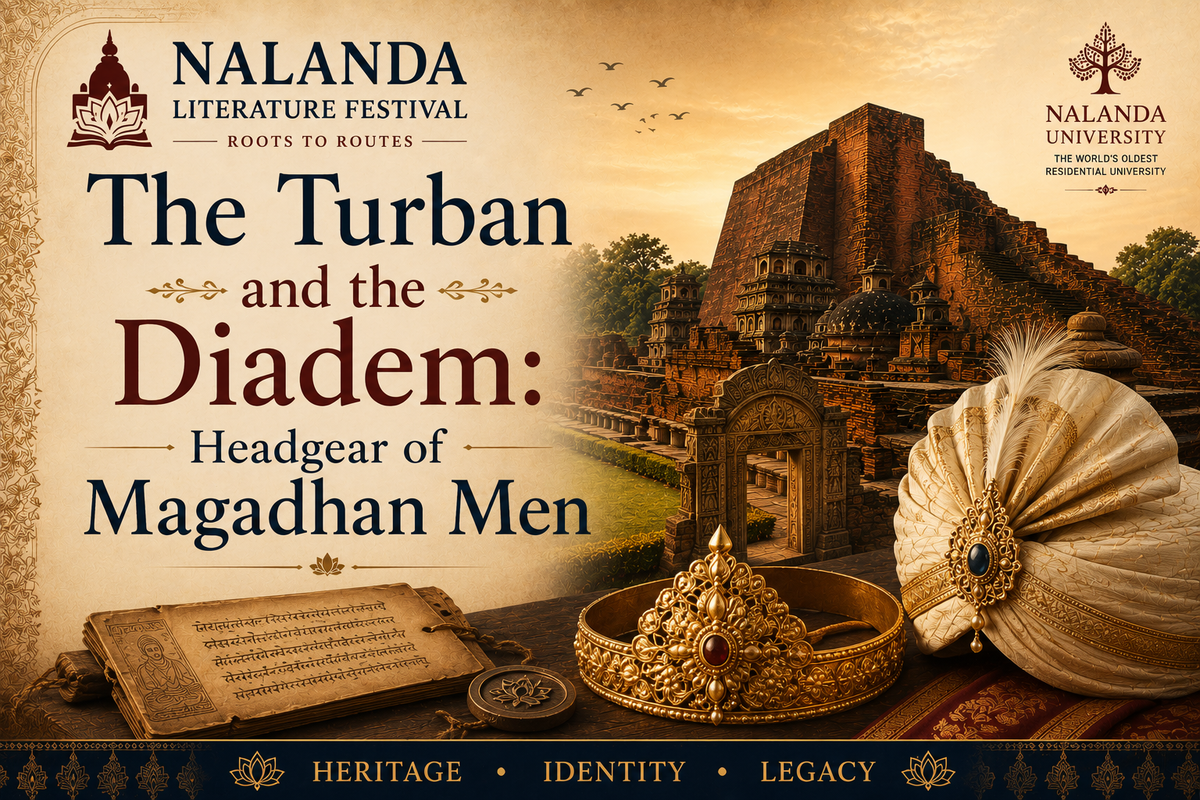
How a wrapped cloth, an off-centre knot, and a crest-jewel announced a man’s rank in ancient Bihar
In the bustling urban centres of ancient Pataliputra and Rajgir, a man’s headpiece told the world precisely who he was before he uttered a single word. Male headgear in Greater Magadha was an intricate blend of civic authority, martial pride, and cosmopolitan trade influences, captured vividly in the archaeological record of Bihar.
The Ushnisha and the Kaparda: Foundations of Male Adornment
The foundational mark of elite male adornment in ancient Magadha was the ushnisha — a tight, meticulously wrapped fabric turban. The Sanskrit word ushnisha (Pali: unhisa) originally meant simply a turban or headcloth, something wound round the head. It carried deep cultural weight: the Mahavastu and the Milindapanha list the ushnisha among the marks of a chakravartin, an ideal world-ruler, alongside a parasol, a vajra, a whisk, and sandals — all symbols of kshatriya sovereignty. Early Mahayana art from Mathura even depicts bodhisattvas in a form called ushnishin, “wearing a turban,” as a sign of their royal lineage.
Magadhan men gave this pan-Indian headpiece a distinct regional signature. Excavated terracotta heads from Mauryan and Sunga layers at sites like Kumrahar and Bulandibagh show that the turban cloth — often made of fine linen (kshauma), the prized fabric of the Gangetic plain — was wrapped around a central topknot of hair known as the kaparda. The term kaparda, which literally means “snail-shell,” refers to the tight, spiralled form of this topknot, a hairstyle whose roots reach back to the Rig Veda, where terms like opasa, kaparada, and stuka describe various arrangements of braided and bound hair. In the terracotta record, this topknot is frequently positioned to one side of the head, creating the sharp, asymmetrical silhouette that became a signature of Magadhan male style.
The Mukut and the Chudamani: Crowns of Authority
For royalty, high officials, and aristocracy, the turban was further embellished. Kings and noblemen adorned their ushnisha with a mukut — a metallic frontlet or diadem made of beaten gold or silver, inlaid with precious stones. The Sanskrit lexicographer MonierWilliams defines the mukut as crescent-shaped, distinguishing it from the pointed kirita and the three-pointed mauli. The Brhatsamhita of Varahamihira references diamondstudded mukuts worn by kings, while the Manasara prescribes that the height of a chakravartin’s mukut should extend to the extremity of his hair, with a crest-jewel rising above it.
At the centre of the crest sat the chudamani, a radiant crest-jewel pinned or tied into the crown. The Mahabharata describes the chudamani as a single perforated gem fastened with a string passed through its centre, often using the compound “baddhachudamani” to emphasise this tied fastening. The Markandeya Purana calls it the foremost of all ornaments, and in the Devi tradition, the ocean of milk itself produces a divine chudamani for the goddess. In the court assemblies and religious ceremonies of Magadha, this single gem — catching the lamplight above a gold diadem — would have been the most concentrated visual token of sovereign power a man could wear.
A Cosmopolitan Fashion: Foreign Caps and Hellenistic Echoes
As Magadha expanded its trade networks across Asia, male fashion evolved to reflect these global connections. By the late Sunga and Kushan periods, terracotta figurines from Patna display a fascinating diversity of male headwear. Beyond the traditional folded turban, men were depicted wearing tight-fitting conical caps, pillbox hats, and padded helmets. The Pataliputra excavation reports describe “small terracotta heads wearing curious headdresses folded square and draped around the cheeks, which surprisingly project an Egyptian appearance,” alongside terracotta heads with “typical Kushana headdresses.” These styles mirror the influx of foreign merchants, soldiers, and emissaries travelling along the trade routes converging at Pataliputra.
A notable example is the terracotta male head from Bulandibagh, now in the Cleveland Museum of Art, which shows a large, elaborately wrapped turban and an earring — leading scholars to suggest it may represent a yaksha, a nature divinity associated with wealth and prosperity. The Bihar Museum’s analysis of the Bulandibagh “Smiling Boy” notes that his headdress displays “elaborate styles of the Hellenistic Period,” confirming that “certain sophistication and the art of dress in the Mauryan court were inspired by the Greeks.” Whether navigating court politics or urban marketplaces, the Magadhan man wore his status proudly upon his head — and his headwear, in its fusion of indigenous turbans, royal diadems, and imported caps, told the story of an empire at the crossroads of the world.