

Five Lands, One Bhakti: Gauri Ganesh and Mahadev Pujan Across Bihar’s Ancient Regions
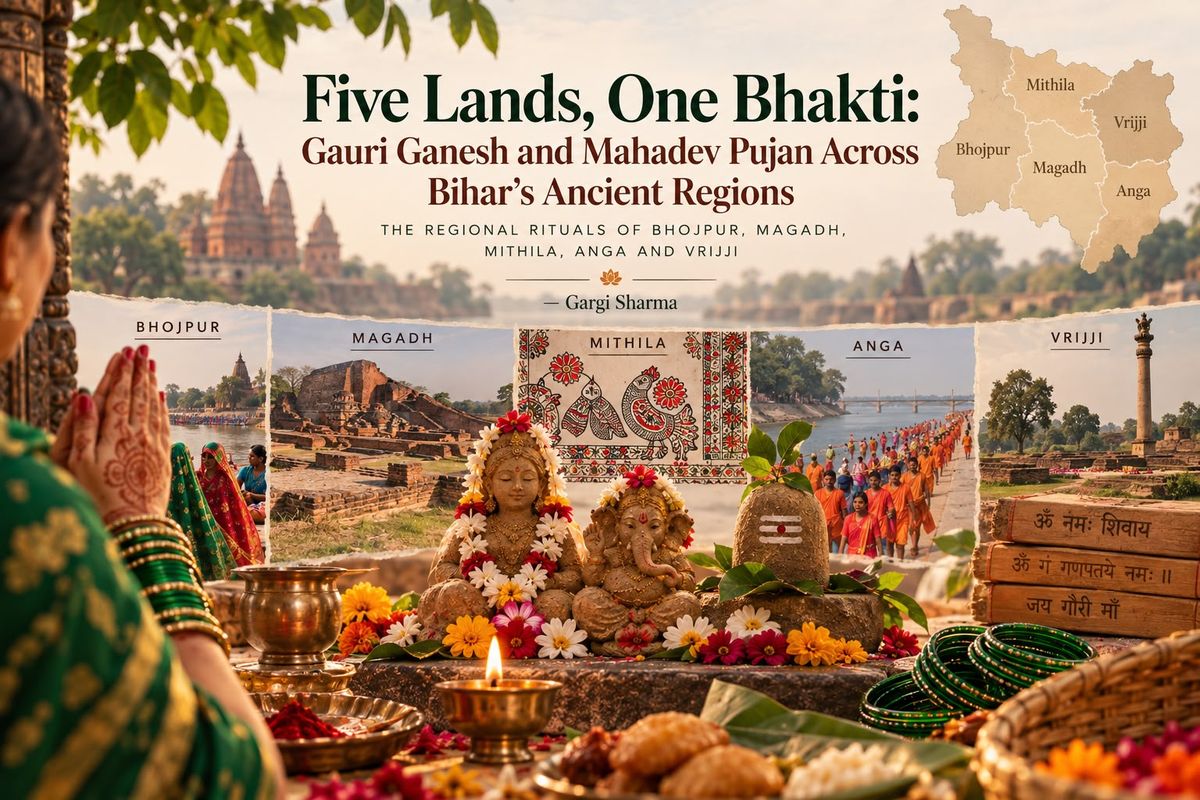
The regional rituals of Bhojpur, Magadh, Mithila, Anga and Vrijji
Speak of Bihar’s festivals and most people reach for Chhath. But running beneath it is an older, quieter current — the pujan of Gauri, Ganesh and Mahadev — and it does not look the same everywhere. Bihar is a mosaic of five ancient cultural regions: Bhojpur in the west, Magadh at its heart, Mithila in the north, Anga in the east, and Vrijji, land of the old Vajji confederacy of Vaishali, in the north-centre. Each keeps the same deities in its own dialect of devotion.
In the Bhojpuri-speaking west — Bhojpur, Buxar, Rohtas, Kaimur — Hartalika Teej is the great women’s festival. On the vrat day, married women take the vermilion they wear not from any new box but from the sinhora, the vermilion casket of their own wedding, a gesture that binds the fast to the marriage itself. Homes fill with the smell of thekua and pidukiya frying in ghee, Sawan Mondays crowd the region’s Shiva temples, and on Kajari Teej the countryside sings kajri — the Bhojpuri heartland’s folk songs of a daughter’s longing — to Shiva and Parvati.
At the heart of Magadh — Patna, Nalanda, Gaya, Nawada — the vrat is a collective affair: women gather in courtyards to shape the idols together, listen to the katha in each other’s company, and keep the jagran with neighbourhood bhajans. Magadh also holds one of India’s most storied seats of Gauri worship: the Mangla Gauri temple at Gaya ji, counted among the Shakti Peethas, where Gauri is revered as the blessor of suhaag — marital fortune — and where married women have climbed to pray for their husbands’ long lives for centuries. Nalanda, home of this festival of letters, sits in the middle of this devotional landscape.
North Bihar’s Mithila keeps perhaps the most literary tradition of all. The vrat is known by its old Maithili name, Haritali, recorded in the region’s ritual literature. A mandap is raised in the courtyard and draped with mehraab (arches) and pathaka (pennants); a four-armed Gauri of clay is installed beside Mahadev seated on Basaha, his bull. Aripan — floor paintings drawn in rice paste with a touch of vermilion — sanctifies the ground. And on the Chaturthi that follows, Mithila does what the rest of India fears: it looks straight at the moon. In Chaurchan, the Chauth Chandra festival, the moon of Ganesh Chaturthi — which tradition elsewhere declares kalankit, “tainted”, and forbids — is deliberately seen, honoured and offered arghya with kheer, puris and fruit. The region’s lore traces the custom to King Hemangad Thakur and Queen Hemalata of the sixteenth century, who celebrated the “moon of Mithila freed of its stain”.
In Anga — Bhagalpur, Banka, Munger, Jamui, Khagaria — Teej is affectionately called Mai ki Teej, Mother’s Teej. Women draped in red-green chunris, with mahawarstained hands, nath and tikuli, sing songs such as “Teej ke din Mai ke jot uthe” and keep katha-gatha vigils through the night. Anga’s Mahadev pujan has its own epic dimension: at Sultanganj on the Ganga, devotees of Ajgaibinath Baba fill their kanwars with river water in Shravan and carry them on foot across a hundred-odd kilometres to Baidyanathdham, filling the region’s roads with song.
The old Vrijji land — Vaishali, Muzaffarpur, the Tirhut belt — joins Teej to the moon. On the eve of the vrat its bazaars do brisk trade in lahathi, sweetened beaten rice, and makai ke baal, the silky corn-tassels used to deck the idols; and on the Chaturthi evening after Teej, households spread banana leaves with kheer, puris, curd set in earthen handis and seasonal fruit, and offer arghya to Chandradeva in the Chaurchan rite. Five regions, five vocabularies — but one grammar of faith: Gauri’s vow, kept by women, in the language of the land they live in.At the heart of