

From Pataliputra to Bharat Mandapam: The Magadh in India’s BRICS Moment
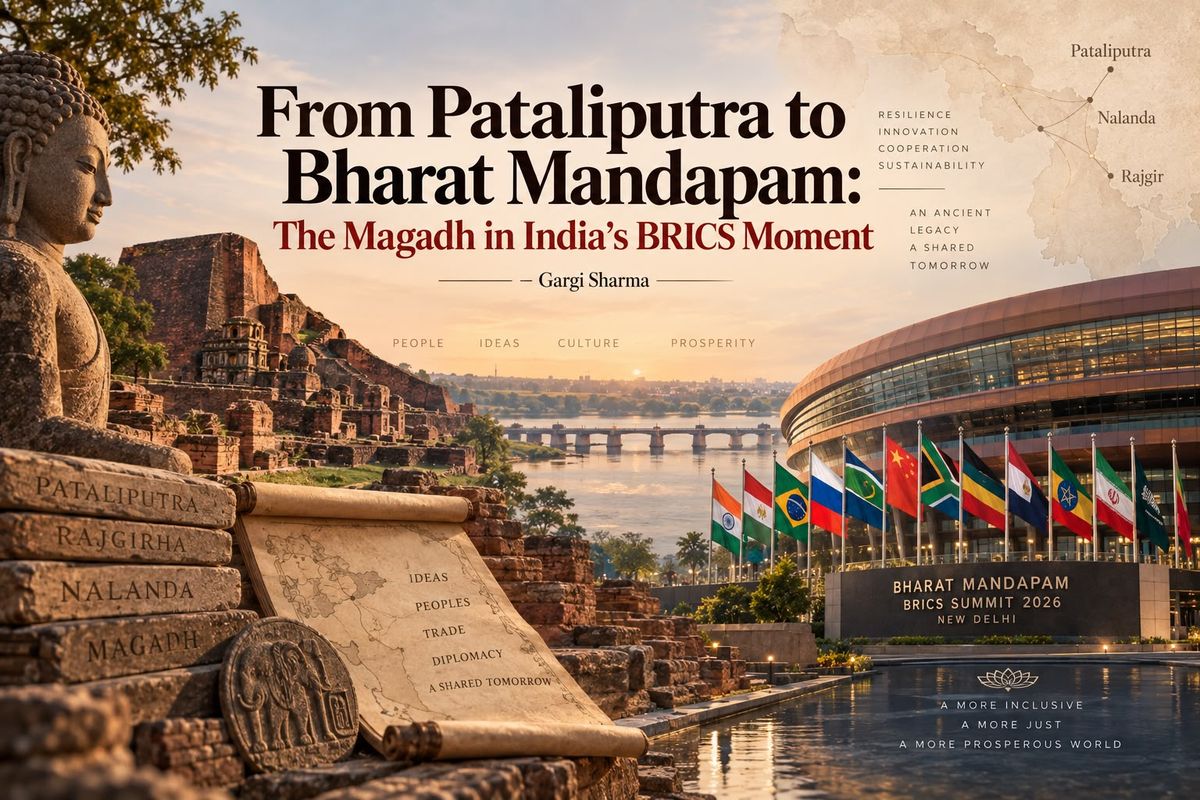
As eleven nations gather in New Delhi this September, the world’s newest diplomatic table is set on the foundations of its oldest. India’s BRICS chairship is not merely a diplomatic exercise — it is a civilizational homecoming. And the ghost that walks through it is Magadh.
When the leaders of the BRICS bloc assemble at Bharat Mandapam on 12–13 September, they will be standing on terrain that, in a civilizational sense, has hosted summits before. The 18th BRICS Summit brings together eleven nations that together represent nearly half the world’s population and about 40 per cent of its GDP. India’s chosen theme — “Building for Resilience, Innovation, Cooperation and Sustainability” — is a neat acronym, but the spirit behind it is older than any acronym. It is the spirit of a land that, two and a half millennia ago, ran the world’s first experiment in cosmopolitan diplomacy from a city on the Ganges: Pataliputra.
Long before Brussels, Geneva or New York, the business of hosting the world was done from the river-girt capital of Magadh. Chandragupta Maurya received the Greek ambassador Megasthenes at his court around 300 BCE, and the envoy went home so impressed that he wrote an entire book — the Indica — describing a city and an administration that dwarfed anything the Hellenistic world could muster. This was soft power before the term was coined: Pataliputra did not need to invade the visitor’s imagination; it simply overwhelmed it.
But Magadh’s summit-craft went further than ceremonial hospitality. Ashoka, after the bloodsoaked Kalinga war, turned his court into something the world had not seen — a state built on dhamma, on ethical conduct as foreign policy. Rock Edict XIII records envoys sent to the courts of five Hellenistic kings: Antiochus of Syria, Ptolemy of Egypt, Antigonus of Macedon, Magas of Cyrene and Alexander of Epirus. This was, by most reckonings, the first systematic state-led cultural diplomacy in recorded history — conducted not from Rome or Athens, but from a capital that today is a busy junction in Bihar.
Nor was diplomacy the only global exchange Magadh hosted. At the Saptaparni cave in Rajgriha, the First Buddhist Council convened around 483 BCE — a gathering of scholars from across the known world to codify a body of thought. Three centuries later, the Third Council at Pataliputra would dispatch missions as far afield as Sri Lanka and Suvarnabhumi. These were the BRICS conclaves of antiquity: councils where ideas, not armies, were the negotiating currency.
And then there was Nalanda — the original international university. For nearly eight centuries, scholars from China, Korea, Tibet, Sri Lanka and Southeast Asia travelled to a single campus in the Bihar plains to study logic, medicine, mathematics, astronomy and philosophy.
Xuanzang and Yijing returned home with manuscripts that would shape East Asian civilisation for a thousand years. Nalanda was, in effect, a standing people-to-people pillar — the very thing BRICS today lists as its third axis of cooperation.
“The idea of confluence is not a slogan borrowed from a brand consultancy. It is the working philosophy of a river plain where civilisations met.”
This is the inheritance that quietly underwrites India’s BRICS chairship. When a “BRICS Friendship Mural” inspired by the Sanskrit word sangam — confluence — is unveiled at the summit, it is worth remembering that the idea of confluence is the working philosophy of a river plain where the Ganga, the Son and the Gandak meet, and where, for a thousand years, civilisations met too.
Which raises the question India should be asking itself this September: if the people-to-people pillar is genuinely central to BRICS, why is the state that produced the world’s first international university not at the centre of that pillar? There are concrete ways to encash this heritage, and they are not nostalgic.
First, the Nalanda axis. The modern Nalanda University, conceived at the East Asia Summit and opened on a net-zero campus designed by Pritzker laureate B.V. Doshi, is already an international institution with partner countries across Asia. India could position it as a BRICS academic hub — a venue for the BRICS Academic Forum, joint research chairs in sustainability and traditional knowledge, and scholarships that bind the bloc’s scholars to the very soil where international scholarship was born. That is soft power with a return-oninvestment no marketing campaign can match.
Second, the Buddhist circuit. Bodh Gaya, Rajgir, Nalanda and Vaishali form a pilgrimage arc sacred to nearly half a billion Buddhists — many of them in BRICS or partner countries, including China and Russia. Tying the BRICS people-to-people calendar to this circuit, with cultural exchanges, relic exhibitions and academic symposia, turns a religious geography into a diplomatic bridge. BRICS need not be only about trade balances; it can also be about shared sacred geography.
Third, the cultural economy. When the summit gala stages a “BRICS Symphony” of Bharatanatyam, Kuchipudi, Odissi and Kathak, it performs a national treasury of dance. But Bihar’s own performing traditions — the folk theatres, the Bidesia tradition, the SamaChakeva — deserve a seat at that table too. A BRICS cultural partnership that channels Madhubani painting, Patna Kalam and Mithila craft into bloc-wide exhibitions would convert heritage into livelihoods, exactly as the people-centric “humanity first” framing of this chairship promises.
The temptation, when hosting a summit, is to treat heritage as backdrop — a decorative quote on a banner. Magadh’s lesson is the opposite. Heritage, in this part of the world, was always infrastructure: infrastructure for ideas, for trade routes, for the movement of scholars. India’s BRICS moment will be measured not only by the New Delhi Declaration it produces, but by whether it remembers that the table it sits at was, in every sense that matters, first laid in Bihar.
Magadh is not waiting to be rediscovered. It is waiting to be used.