

The Land That Taught the World Is Ready to Host It: Bihar’s Road to the Summit Table
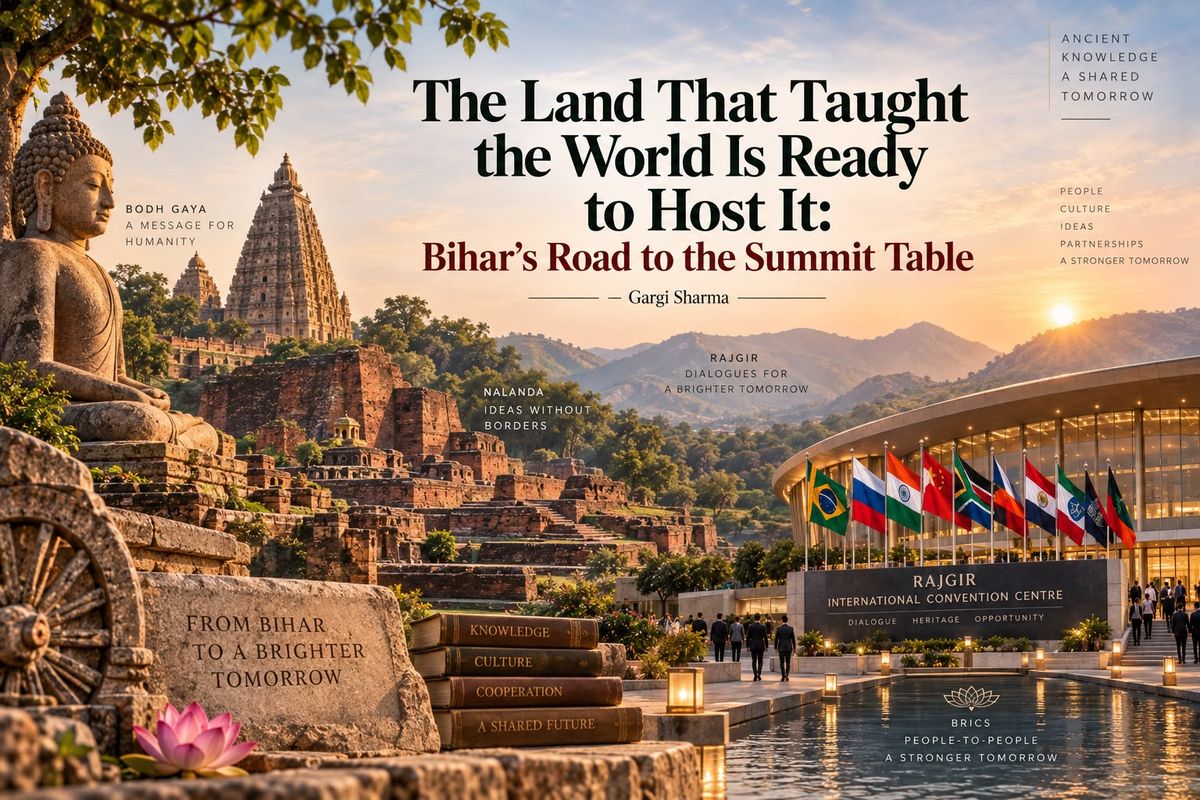
As the BRICS flag flies over New Delhi, a quieter question is taking shape a thousand kilometres east: why must the world’s great gatherings always bypass the land where the idea of the global university was born? Bihar is not asking for charity at the summit table — it is presenting its credentials.
There is a particular irony in watching the world’s leaders arrive in India this September for the 18th BRICS Summit, and noticing that the one Indian state whose name is synonymous with international knowledge exchange is, once again, watching from the stands. Bihar sent its scholars to China a millennium before the phrase “people-to-people exchange” existed. It hosted councils that shaped the religious geography of half of Asia. It built universities that drew students from Korea to Ceylon. And yet, when the world convenes to talk about cooperation and sustainability, the conversation never quite reaches Rajgir.
It should. And not as a sentimental gesture — as a strategy.
Start with what Bihar already has, because no other Indian state can list it. The Mahabodhi Temple at Bodh Gaya, where the Buddha attained enlightenment, is a UNESCO World Heritage Site. So is the Archaeological Site of Nalanda Mahavihara — twenty-three hectares of viharas, stupas and lecture halls that constituted the world’s first residential university. The Barabar Caves, cut into the hills by Chandragupta’s grandson, are the oldest surviving rockcut caves in India, gifted to the Ajivika ascetics two centuries before Christ. Vikramshila, Odantapuri, the buried remains of Pataliputra — each is a chapter in a story the world has forgotten it is part of.
Then there is the living heritage. Madhubani painting, once the wall-art of Mithila villages, now hangs in galleries from Tokyo to Toronto. The Patna Kalam school, born of Mughal patronage and European observation, produced a miniature tradition found nowhere else. The Sonepur Mela is among the largest cattle fairs in Asia. Chhath, Bihar’s great river festival, turns the Ganga’s banks into a spectacle of devotion that no summit gala can replicate. This is not heritage under glass — it is heritage that still breathes, still performs, still earns.
“A civilisation does not get to host the world’s first international university and then be told, two thousand years later, that it is not ready to host a meeting.”
The infrastructure is catching up to the inheritance. The Rajgir International Convention Centre, set in the hills where kings once held court, already hosts the Rajgir Dialogue — India’s premier annual defence and security exchange. If Bihar can convene strategic thinkers on geopolitics, it can convene ministers on culture. The proposed literary-tourism circuit linking Nalanda, Rajgir, Bodh Gaya and Vaishali is precisely the kind of “experience infrastructure” that modern diplomatic delegations expect. Gaya’s airport holds international status; Bodh Gaya draws pilgrims from across Buddhist Asia. The skeleton of a host exists. What is missing is the ambition to clothe it.
So here is a roadmap, not a wish-list.
Phase one — partake. Bihar does not need to host a full BRICS Summit tomorrow. But it can, and should, bid for the BRICS Cultural Ministers’ Meeting, the BRICS Film Festival, and the BRICS Academic Forum. These are the people-to-people track events that align naturally with a state whose entire brand is people-to-people exchange. The Nalanda Literature Festival, which brings writers and scholars from across India and abroad to Rajgir each December, has already demonstrated that the land can stage a world-class cultural congregation. Scaling that model to a BRICS cultural track is a small leap.
Phase two — leverage. The modern Nalanda University, with its international mandate and its architecture by B.V. Doshi, is the natural home for a BRICS think-tank on traditional knowledge and sustainability — two pillars of India’s current chairship theme. A “Nalanda BRICS Fellowship” drawing scholars from all eleven member states would, in a single stroke, restore to Bihar its ancient role as the place where the world’s ideas are debated. The economic multiplier of such an institution — in hospitality, in translation and publishing, in academic tourism — would outlast any summit.
Phase three — host. The ambition should be explicit and dated: a future BRICS Summit, or a BRICS-Plus outreach conclave, in Bihar within the next decade. The Rajgir Convention Centre, expanded and connected to Bodh Gaya’s international airport and Patna’s new Jayaprakash Narayan airport, can receive the world. A summit held within sight of a UNESCO World Heritage university would be a symbol no host city in the West can match. Rich terracotta murals and different state art forms on the summit walls. Displaying rich marine fauna(Ganga Dolphin Show) on the Ganga river for the visiting press. A leaders’ photograph against the ruins where Xuanzang once studied. That is not pageantry; it is positioning.
The argument against is the familiar one — infrastructure, security, logistics. These are real, and they are solvable, and they have been solved in harder places. The argument for is older and stronger: a civilisation does not get to host the world’s first international university and then be told, two thousand years later, that it is not ready to host a meeting.
Bihar’s heritage is not a museum. It is a balance sheet, and it has been accruing for two and a half millennia. The question is whether the state — and the country — has the vision to draw on it.
The land that taught the world is ready to host it. It only needs to be asked.