

Lacquer
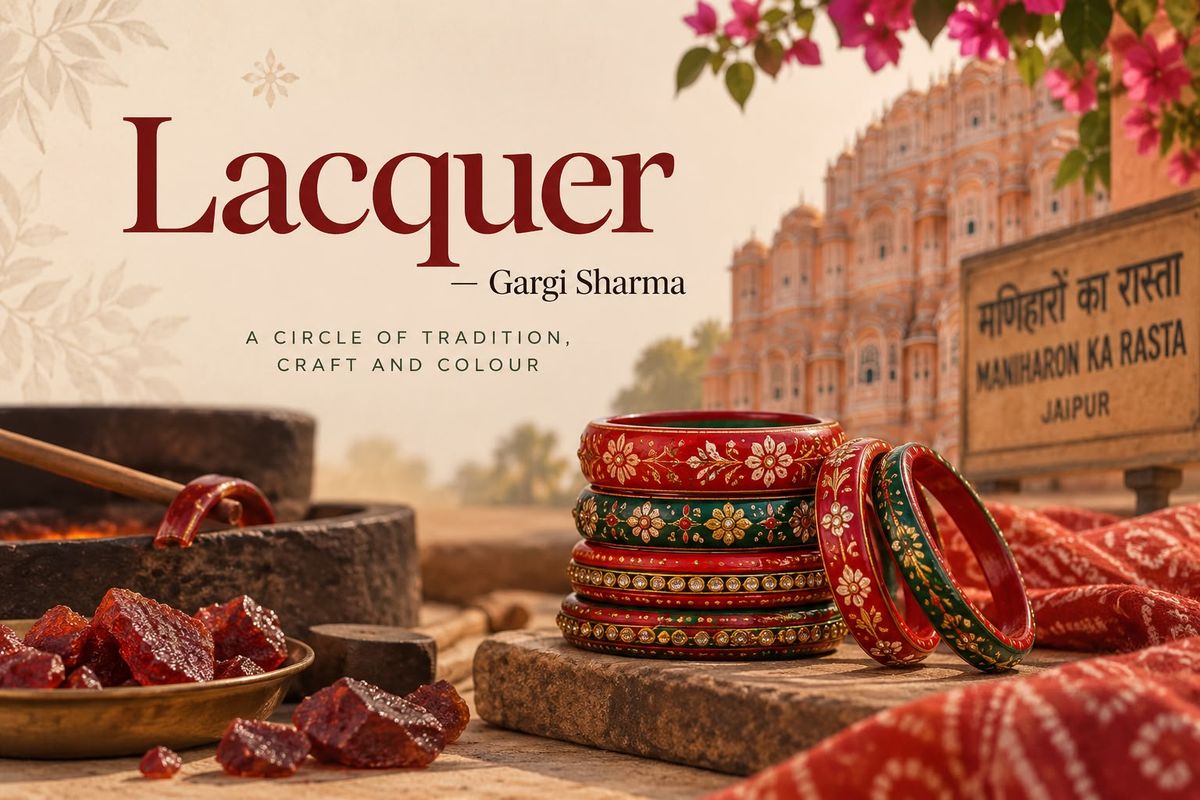
India's love affair with bangles is as old as its civilisation, but few carry the soul of lac bangles — hand-shaped from the natural resin secreted by the tiny Kerria lacca insect on host trees like palash, kusum and ber. Mentioned in the Atharva Veda and woven into the Mahabharata's legend of the lac palace, lac has always been more than ornament; it is substance of ritual.
The craft's beating heart is Maniharon ka Rasta in Jaipur, a lane set aside for banglemakers when Maharaja Sawai Jai Singh II founded the city in 1727. Here, the Muslim Manihar and Hindu Lakhera communities work side by side — men melting raw lac over coal furnaces, women shaping and embellishing the bangles in the shopfronts. A bride's wrist dressed in red and green lac signifies suhaag and fertility; the bangles' gentle clatter is believed to invite prosperity into the home. Designs shift with the calendar — leheriya in Shravan, mothra at Holi, special sets for Teej, Gangaur and Karva Chauth.
But lac bangles are not Rajasthan's alone. The hereditary Lakhera or Laheri caste practises the craft across Bihar, West Bengal, Odisha, Madhya Pradesh and Maharashtra. In Bihar and Jharkhand, even the tribal communities such as the Santhal, Munda and Oraon wear lac bangles alongwith the general populace as markers of marriage and womanhood; in Bengal, lac bangles belong to a bride's trousseau as in Bihar; in Hyderabad and pockets of Telangana, lacquer bangles studded with stones find their own festive demand. What unites them is the material's quiet virtue — lac is skin-soothing, pliable, and can be gently re-heated and re-joined if a bangle ever breaks.
In an age of glass and plastic, the lac bangle survives because it carries meaning no machine can press — a circle of colour on a woman's wrist, linking forest, insect, artisan and centuries of custom in one warm, living band.