

Lahthi
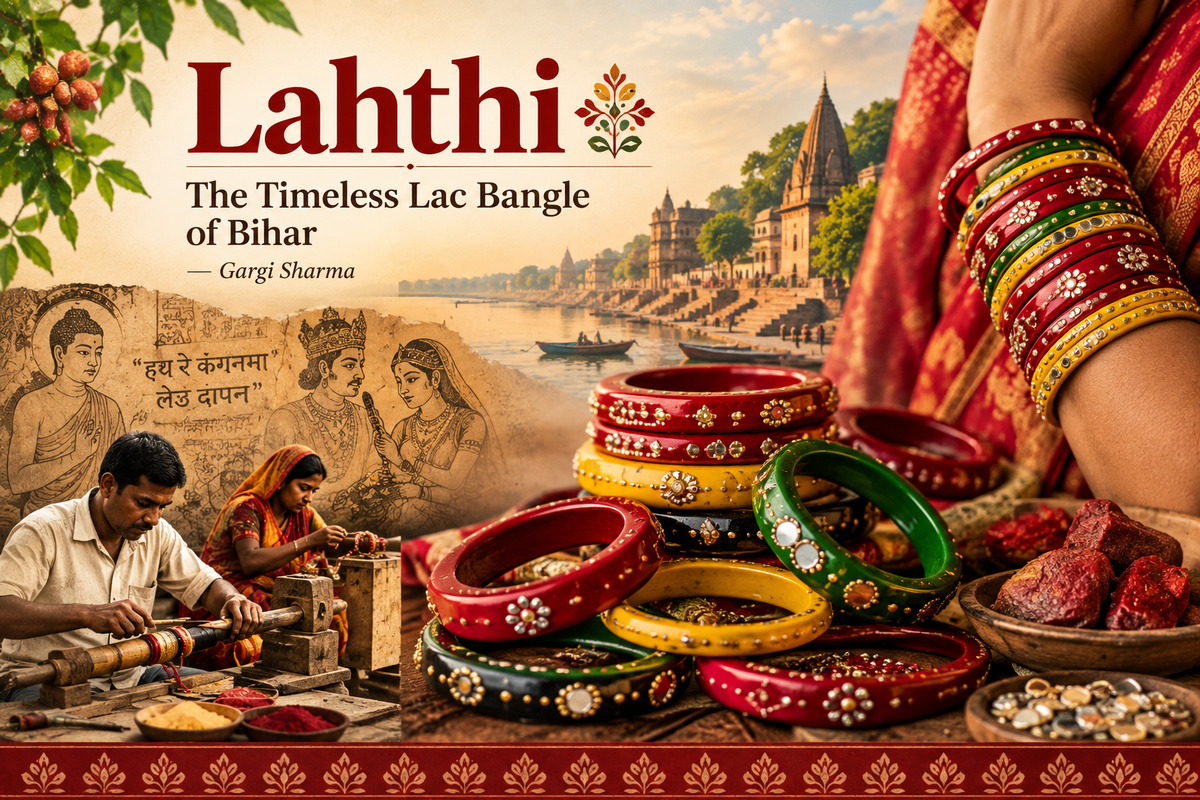
In Bihar, the lac bangle is not merely an ornament but a continuum of memory. Known locally as Lahthi, it appears in the Charyageet — the Buddhist songs of the 8th-12th centuries — where a monk writes "hath re kanganma leu dapan", celebrating the bangle's hold over beauty itself. The Maithili poet Vidyapati placed Lahthi on Sita's wrist in Mithila, and oral narratives link it to Shiva's gift to Parvati. The craft is thus woven into the very antiquity of Bihar.
The land itself nurtures the craft. Bihar's forests are rich in lac-bearing host trees — palash, kusum and ber — upon which the tiny Kerria lacca insect secretes its resin. Five million people, largely tribal communities, are tied to this lac economy. The hereditary Laheri or Lakhera caste, whose name descends from the Sanskrit lakshakara (worker in lac), has shaped bangles here for centuries. Among the Bhumij, Munda, Oraon and Santhal peoples, lac bangles mark marriage and womanhood.
Muzaffarpur emerged as the craft's great modern centre. The Rampur Bakhari cluster supplies nearly 55% of Bihar's Lahthi and about 45% of the national market, while the Islampur Lahthi market — over 250 shops — sends bangles across India and to Nepal, Bangladesh, Canada and the US. Its monthly turnover runs into crores.
The making is patient and hands-on: lac is melted, kneaded into a dough, coloured, rolled thin, shaped on the wooden hatta and khali, then set with stones, beads and mirrors. Men prepare the base; women handle the delicate embellishment from home.
Ritually, Lahthi is inseparable from Bihari life. Brides wear red-and-yellow bangles for the first forty days, sometimes the whole first year. During Chhath Puja, pure lac bangles with no metal core are considered especially sacred. Each colour speaks — red for fertility, yellow for auspiciousness, green for growth, black to ward off ill.