

What the Soil of Magadh Knows: Gandhi, Nalanda and the Meaning of Swaraj
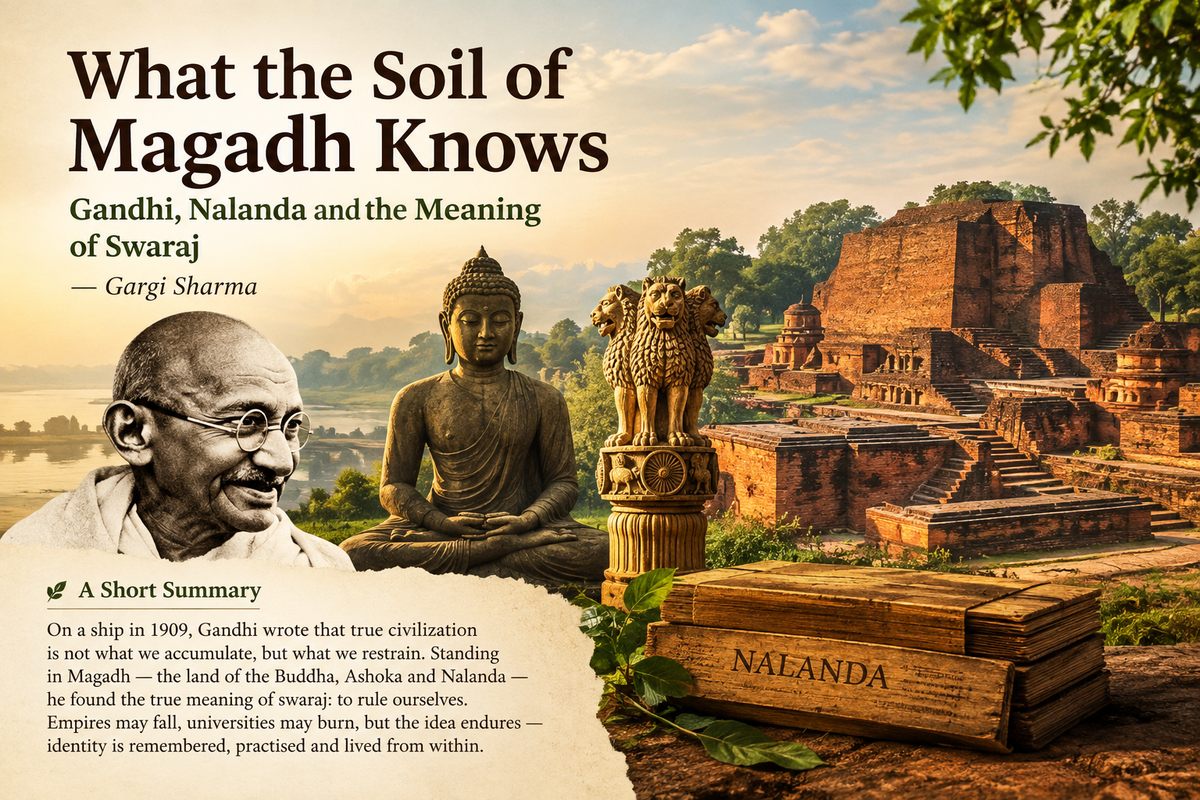
In 1909, on a ship home from London, Gandhi wrote a small book with a large question. Civilization, he insisted, is not what a society accumulates but what it restrains — “that mode of conduct which points out to man the path of duty.” And he issued a warning that still stings: a nation that gains the world's machinery but loses its own self has merely exchanged masters. An India that became English would not be Hindustan at all — it would be “Englistan.”
Stand in Magadh, and the question stops being abstract. This is the land where the Buddha sat beneath the Bodhi tree and taught that mastery over the self precedes mastery over the world — the very grammar of Gandhi's swaraj: “It is Swaraj when we learn to rule ourselves.” It is where Ashoka, washed in the blood of Kalinga, laid down the sword of the king for the sword of ethics — precisely the civilizational preference Gandhi praised in Hind Swaraj. And it is where Nalanda stood for seven hundred years, proving that a civilization's true wealth is not its arsenal but its inquiry.
Gandhi observed that Rome went, Greece fell, the might of the Pharaohs was broken — “but India is still, somehow or other, sound at the foundation.” Magadh is that foundation, still breathing. Its empires dissolved; its great university burned. Yet the idea returned — Nalanda lives and teaches again.
That is the parallel this soil offers us: identity, like swaraj, is not something given or seized. It is remembered, practised, and ruled from within. The rest — the flags, the armies, the GDP — follows or fades.