
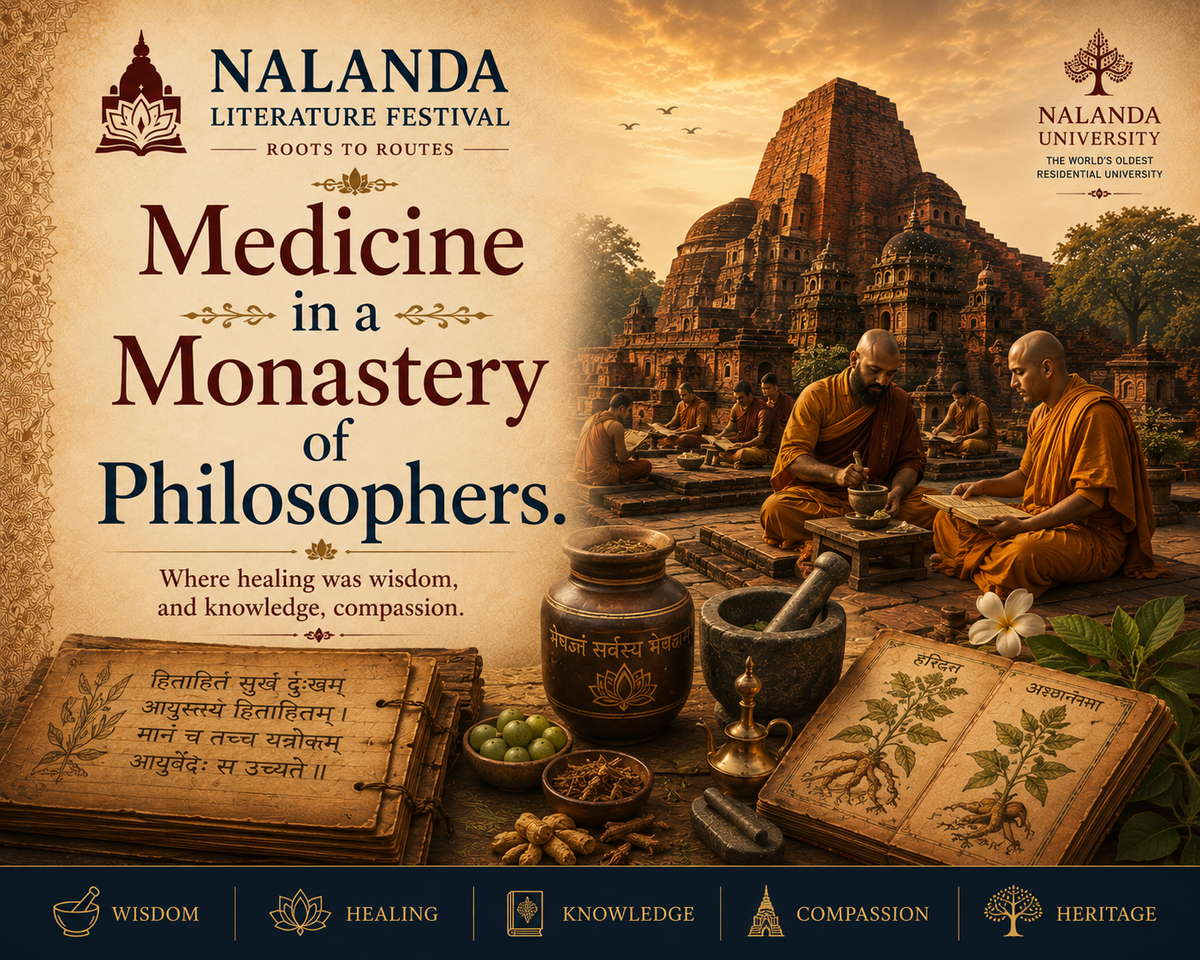
Medicine in a Monastery of Philosophers.
Nalanda's curriculum included medicine. To modern eyes this may seem like a practical addition to an otherwise philosophical institution. Within Buddhism, however, medicine and Dhamma share a deep conceptual relationship. Both begin by acknowledging affliction, seeking its cause, imagining recovery, and applying a method of treatment.
The Four Noble Truths are often compared to a medical procedure. Dukkha is diagnosed. Its causes are investigated. The possibility of cessation is affirmed. The path supplies the treatment. This analogy should not reduce spiritual life to a clinical formula, but it explains why Buddhism frequently presents itself as therapeutic rather than speculative.
The famous story of Malunkyaputta sharpens the point. A man wounded by a poisoned arrow refuses treatment until he knows who fired it, what caste the attacker belonged to, what material formed the bow, and other irrelevant details. He dies before receiving answers. The Buddha uses this image to distinguish urgent liberation from questions that do not contribute to it.
Nalanda's medical studies brought this therapeutic attitude into direct contact with bodily suffering. Monastic communities had to care for illness, injury, aging, poor sanitation, and epidemics. Philosophical insight did not make the body invulnerable. Compassion required practical knowledge.
Buddhist discipline had long regarded care for the sick as a serious communal duty. The body was neither worshipped as a permanent self nor despised as an obstacle. It was a conditioned basis for practice. Neglecting it could shorten life, weaken attention, and burden others.
Medicine also offered a lesson in causality. Disease rarely emerges from a single isolated source. Diet, environment, constitution, infection, behavior, and mental state may interact. This resembles dependent arising, which examines how suffering develops through interlocking conditions. Neither approach requires an unchanging essence behind the process.
At Nalanda, medical knowledge probably circulated across cultural boundaries. Students and travelers brought regional practices, botanical information, and diagnostic traditions. Translation networks later carried Buddhist medical ideas into Tibet and other parts of Asia. The monastery thus functioned as both a spiritual center and a channel for practical knowledge.
Still, the relationship between medicine and Dhamma contained an important limit. Physical treatment can ease pain and prolong life, but it cannot abolish aging and death. Buddhist practice addresses the grasping, fear, and confusion through which unavoidable pain becomes further suffering. The two forms of care overlap without becoming identical.
This distinction prevents spiritual cruelty. Telling a sick person that pain is merely attachment can become a way of refusing help. Nalanda's inclusion of medicine suggests a more mature response. One treats the wound and examines the mind. Compassion reaches for remedies while wisdom recognizes their limits.
There is also an ethical dimension to intention. Buddhist thought emphasizes that actions of body, speech, and mind acquire moral significance through the motives shaping them. Medical skill without benevolence can become exploitative. Good intention without competence can become dangerous. Genuine care requires both compassion and knowledge.
Nalanda's physicians and philosophers therefore inhabited related worlds. One studied the body's imbalance. The other studied the mind's bondage. Both needed observation, discipline, humility, and patience.
The rare lesson is that Dhamma was never only a conversation about distant enlightenment. It entered the sickroom. It confronted fever, exhaustion, wounds, and mortality. At Nalanda, wisdom had to know how to debate, but it also had to know when to prepare medicine and sit beside the suffering.